
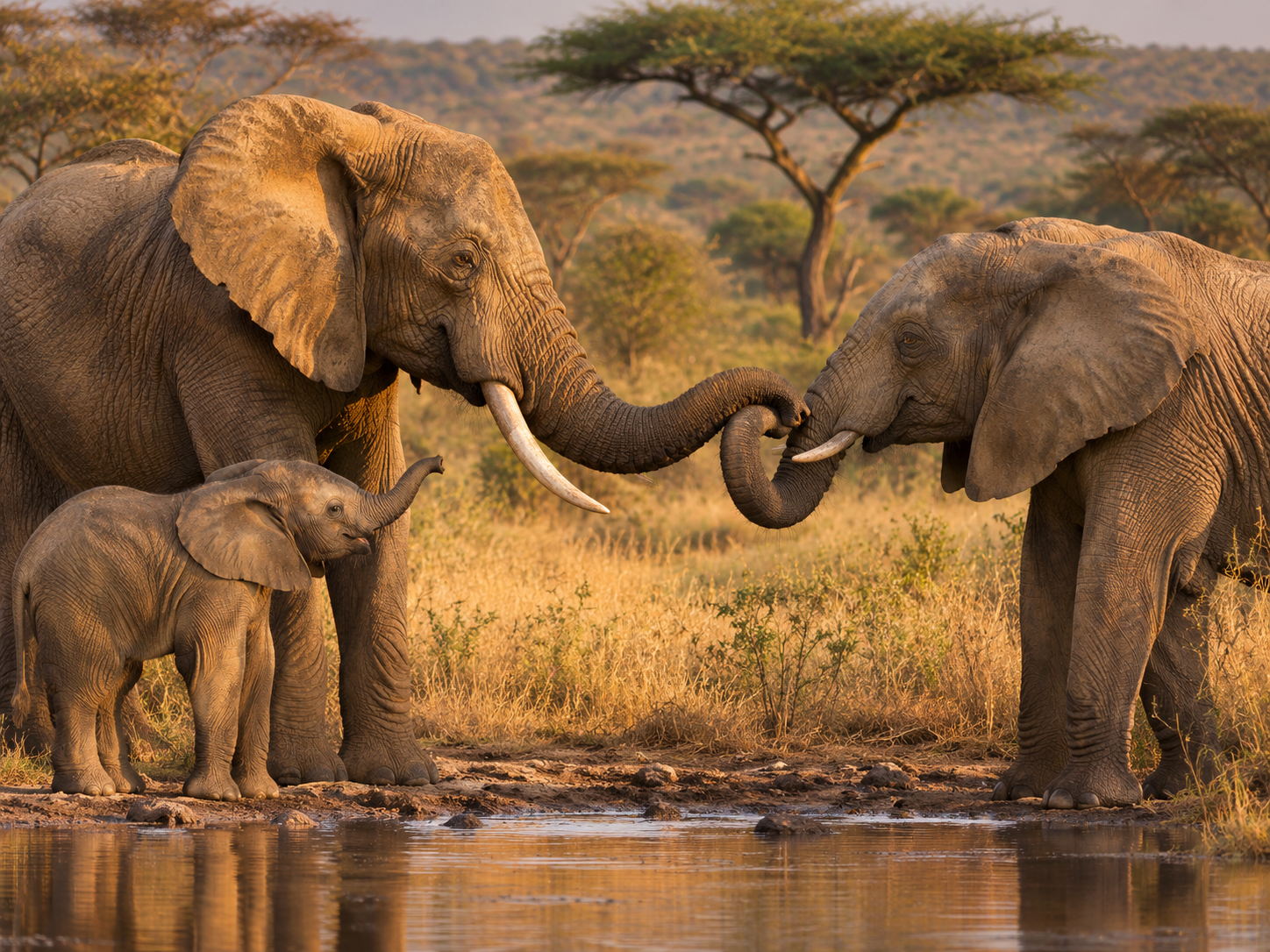
New research is revealing a remarkable world of elephant communication, from individual calls to intentional gestures and conversations we are only beginning to understand.
Imagine sitting quietly in a safari vehicle, watching a family of elephants gathered beside a waterhole.
An enormous female stands near the water, her trunk moving slowly through the surface. A younger elephant approaches, followed by a calf keeping close to its mother. Another adult turns its head, spreads its ears and appears to direct its attention towards a companion.
For a moment, nothing particularly dramatic seems to happen.
There is no loud trumpet. No charging elephant. No obvious confrontation.
Yet something interesting may be taking place.
The elephants could be communicating with one another through movements, low-frequency calls, touch and signals that a casual observer might not even recognise.
And according to fascinating new research published in 2026, those signals may be far more deliberate and sophisticated than many people realise.
Scientists have discovered that wild African elephants can use a remarkably varied collection of gestures to influence one another’s behaviour. Other researchers have found evidence that elephant vocalisations may become more coordinated as groups communicate.
These discoveries are changing the way we understand one of Africa’s most extraordinary animals.
For anyone who loves wildlife, it is a wonderful reminder that a safari is not simply about seeing animals.
It is about discovering the hidden lives unfolding before our eyes.
Africa’s Giants Are More Than Their Size
The African savannah elephant (Loxodonta africana) is the largest living land animal.
Its size alone makes it unforgettable. An adult elephant can stand several metres tall, carry enormous tusks and move through the landscape with a presence few other animals can match.
But physical strength tells only a small part of the elephant’s story.
Elephants live complicated social lives. Female-led family groups maintain relationships over many years, while adult males generally follow different social patterns as they mature.
Within elephant families, individuals recognise familiar companions, respond to calves, maintain contact and coordinate movement.
Their relationships are not always simple.
Sometimes elephants cooperate. Sometimes they greet one another enthusiastically. Sometimes they compete over space, food or water.
And throughout these interactions, they communicate.
Until recently, much of the scientific attention given to elephant communication focused on their sounds and sense of smell.
The latest research shows that their movements and gestures deserve just as much attention.
A Remarkable 2026 Discovery: Elephants Communicate With Intentional Gestures
In September 2026, researchers published a study in the scientific journal Animal Cognition examining how wild African savannah elephants communicate during competitive encounters.
The findings were fascinating.
Researchers studied elephants in two South African national parks: Addo Elephant National Park in the Eastern Cape and Marakele National Park in Limpopo.
Across more than 90 hours of observation, they recorded approximately 840 instances of elephant gestures.
Their analysis identified 41 gesture types arising from 32 different actions.
The gestures included visual movements, audible signals and physical contact.
More importantly, the researchers found evidence that elephants were not merely moving randomly or reacting without awareness.
They appeared to direct their gestures towards other elephants to achieve particular outcomes.
In competitive situations, the researchers identified two broad communication goals:
- Encouraging another elephant to move away.
- Getting another elephant to stop what it was doing.
These descriptions are interpretations of the animals’ behavioural intentions, not literal translations of elephant words.
Nevertheless, the findings reveal something extraordinary.
Wild elephants appear capable of adjusting their communication according to the situation and the response of the animal receiving the message.
It Is Not Only the Gesture That Matters
One of the most interesting findings was that the elephants seemed aware of whether other elephants were paying attention.
Researchers observed animals visually checking the intended recipient, changing how they communicated and waiting for a response.
When a gesture did not produce the desired result, an elephant sometimes continued signalling.
Imagine how different that is from a simple automatic reaction.
An animal does something to attract another’s attention. It waits. It observes the response. If the other animal does not react as expected, it tries again.
That is a meaningful example of what scientists call goal-directed intentional communication.
It does not establish that elephants use language in the human sense.
It does, however, show a sophisticated ability to influence social interactions.
For safari guests, it offers a completely different way of watching elephant behaviour.
The next time an elephant moves its ears, changes position, extends its trunk or touches another elephant, there may be more happening than meets the eye.
What an Ear Flap Might Really Mean
Elephants use their enormous ears for several purposes.
They help regulate body temperature, and their movements can also contribute to visual communication.
It would therefore be incorrect to assume that every ear movement is a warning.
Context is essential.
An elephant may move its ears while cooling itself. It may adopt a particular posture during an encounter with another elephant. It may combine ear movements with trunk gestures, changes in body position or physical contact.
The 2026 gesture study showed that many gesture types were used flexibly rather than corresponding rigidly to a single meaning.
This is a crucial distinction.
An elephant’s body language cannot be understood through a simple dictionary in which one movement always means one thing.
Just as human gestures depend on the situation, the meaning of an elephant’s movements may depend on what the other animal is doing, their relationship and the wider circumstances.
Researchers found that elephants in Addo and Marakele shared many gesture types, although the gestures they used most frequently differed between populations.
The resources involved in their competitive encounters differed too.
At Addo, water featured prominently, while at Marakele, reeds were an important focus of competition.
This is especially interesting because it demonstrates how communication happens within the practical realities of an animal’s environment.
Elephants are not communicating in isolation from nature.
Their signals are woven into feeding, movement, social relationships and the daily challenges of life in the wild.
The Sounds We Cannot Always Hear
An elephant’s trumpet is one of Africa’s most recognisable wildlife sounds.
But trumpeting represents only one part of its vocal repertoire.
Elephants also produce low-frequency rumbles, some of which contain sound below the normal range of human hearing.
These low-frequency signals can help elephants maintain contact over considerable distances, although the range and effectiveness of communication depend on the environment and conditions.
A group of elephants may therefore exchange acoustic information without producing anything that sounds particularly impressive to people standing nearby.
This is one reason elephant communication has fascinated scientists for decades.
We can watch the animals, hear some of their calls and observe their reactions.
Yet important parts of their communication may be taking place at frequencies we cannot fully perceive without specialised equipment.
And in October 2026, another scientific study offered a remarkable new perspective on these conversations.
The Discovery of Elephant Vocal Choruses
On 1 October 2026, researchers published a study in Scientific Reports examining the overlapping rumbles made by African elephants.
They analysed 902 recordings of single and overlapping rumbles from 84 wild elephants across 39 families in Kenya’s Amboseli National Park.
The recordings had been collected during different periods between 1986 and 2022.
The research team used machine learning to examine how the calls changed during different social situations.
One of their most interesting findings was that elephant rumbles could become more acoustically similar as certain vocal exchanges continued.
These changes were observed in situations involving contact between elephants, greetings and other social interactions.
The researchers suggested that this acoustic convergence may play a role in helping elephant groups coordinate their behaviour.
Think about what that could mean.
A family of elephants preparing to move may be participating in a collective communication process.
When separated individuals reconnect, their vocal exchanges may contain information about the social situation.
As calls overlap, the structure of the resulting chorus may help researchers understand something about how the group communicates.
The research does not prove that elephants hold conversations in the same way humans do. Nor did this study experimentally test how elephants respond to increasingly similar overlapping calls.
But it provides compelling evidence that collective vocalisations contain meaningful information.
The African bush may be filled with far more complicated elephant communication than we can hear.
Elephants Might Even Address Each Other Individually
The new 2026 findings add to another extraordinary discovery published in 2024.
Researchers studying African elephants found evidence that they may use individually specific, name-like calls when addressing other elephants.
The study, published in Nature Ecology & Evolution, combined acoustic analysis with playback experiments.
The researchers found that information about the intended recipient appeared to be encoded in certain calls.
Elephants also responded differently when researchers played calls originally directed towards them compared with calls directed towards another animal.
It was an exciting result.
Unlike some animals that address companions by imitating their characteristic sounds, elephants appeared capable of using signals that did not simply copy the recipient’s own vocalisations.
Scientists described these as name-like calls.
That does not mean elephants have personal names identical to human names or that every elephant possesses a universally recognised vocal label.
The research is more precise than that.
It suggests that elephants can address particular individuals using distinctive acoustic information.
For animals living in complex social groups, the ability to communicate with specific companions could be extremely useful.
It might help separated family members maintain contact or allow mothers and offspring to communicate within larger groups.
And it opens fascinating questions about what else elephants may be capable of expressing.
The Elephant Family: Where Communication Matters Most
To understand why communication is so important to elephants, it helps to look at their social lives.
Female African elephants commonly live in family units led by an experienced matriarch.
These groups can include related females and their young, with relationships extending across generations.
The matriarch’s experience can be valuable when the family encounters unfamiliar circumstances or needs to locate resources.
Young elephants spend years learning about the world around them.
They observe adults, respond to their mothers and interact with companions.
An elephant calf may use its trunk awkwardly at first, gradually developing the coordination that makes this extraordinary organ so versatile.
Adults may touch calves or respond to their vocalisations.
Family members can also maintain close relationships through greetings, movement and physical contact.
These are not merely pleasant details for wildlife enthusiasts.
They are part of the social system that allows elephants to survive.
A family navigating changing food availability, water sources and the presence of other elephants needs ways to maintain cohesion.
Communication helps make that possible.
Why Waterholes Reveal So Much About Elephant Behaviour
Waterholes are among the most fascinating places to observe elephants.
Elephants need regular access to water, and their visits can create opportunities to watch a wide range of behaviour.
A family group may arrive together. Individuals may drink, bathe or interact with other elephants already present.
Younger animals may appear playful, while adults remain attentive to their surroundings.
Sometimes groups approach one another peacefully.
At other times, individuals may compete over access to particular spaces.
The 2026 research from Addo demonstrates that water can be an important setting for studying elephant communication.
For wildlife observers, this makes waterholes particularly rewarding.
Instead of simply photographing the first elephant that arrives, take time to watch the wider group.
Notice how the adults position themselves.
Observe whether one elephant changes direction after another moves or gestures.
Look for gentle trunk contact, changes in body posture or interactions involving calves.
The story may be unfolding between the animals rather than in any one animal’s dramatic pose.
Important safari principle: Elephants are powerful wild animals. Visitors should never approach them to investigate body language, imitate signals or attempt to influence their movements. Remain at a safe distance and follow the instructions of an experienced guide.
The most rewarding observations occur when wildlife is allowed to behave naturally.
What New Elephant Research Means for Photographic Safaris
For photographers, these discoveries offer a different way to think about wildlife images.
An elephant portrait is always impressive.
The textures of its skin, the shape of its ears and the character of its face make extraordinary photographic subjects.
But an image showing interaction can tell an even richer story.
Consider a calf standing close to its mother.
Two elephants touching trunks.
Several animals greeting one another after being apart.
An older female guiding a group towards water.
Or a moment when one animal appears to respond to another’s posture.
These images capture relationships.
They encourage viewers to wonder what the animals were communicating and what was happening within the group.
This is where patience becomes valuable.
A photographer who rushes from one sighting to the next may return with many attractive pictures.
A photographer who spends time observing a single family group may return with a story.
And that story can be far more memorable.
Where Can You Observe African Elephants?
For guests interested in elephant behaviour, several African destinations offer opportunities for photographic safaris.
South Africa has established elephant populations in national parks including Kruger, Addo and Marakele. Each setting provides different habitats and opportunities for wildlife observation.
Botswana’s Chobe National Park is famous for its elephant herds and the wildlife-rich Chobe River. The riverfront can provide memorable opportunities to observe elephants drinking, moving and interacting.
Zimbabwe’s Hwange National Park is another important elephant destination, with water sources playing a significant role in wildlife movement.
Zambia’s major river systems offer further opportunities to observe elephants in environments shaped by seasonal water availability.
Other African destinations, including Tanzania, also provide opportunities to observe elephant families in different habitats.
No location can guarantee a particular behaviour or encounter.
Wildlife sightings depend on the season, habitat, movement and many other factors.
However, a carefully planned photographic safari can give guests the opportunity to spend meaningful time observing these remarkable animals.
At Infinite Safaris Africa, we believe that understanding what guests want to experience is the first step towards building a memorable journey.
For someone fascinated by elephant behaviour, that may mean choosing destinations with established populations and allowing enough time for patient observation.
Frequently Asked Questions About Elephant Communication
Can elephants really talk to one another?
Elephants communicate through sounds, movements, touch and other sensory signals. Research shows that their communication can be highly sophisticated, although it is not equivalent to human spoken language.
Do elephants call each other by name?
A 2024 study found evidence that African elephants use individually specific, name-like calls. This suggests they can address particular companions, but scientists are still investigating how these signals function.
What did scientists discover about elephant gestures in 2026?
Researchers observed 41 gesture types in competitive interactions between wild elephants in South Africa. The findings provided evidence that elephants use gestures intentionally to encourage others to move away or stop particular behaviours.
Why do elephants rumble?
Elephant rumbles occur in several social situations, including maintaining contact, greetings and possible group movement coordination. Research published in October 2026 found that overlapping rumbles can contain information about the social context.
Where can I photograph elephant families in Africa?
National parks and reserves in South Africa, Botswana, Zimbabwe, Zambia and other African countries offer opportunities to photograph elephants. The most suitable destination depends on the season and the experience you want.
The Next Time You See an Elephant, Look Again
The most exciting thing about these discoveries is that they change the meaning of an ordinary wildlife encounter.
An elephant standing beside a waterhole is no longer simply an enormous animal drinking.
It may be part of a family exchanging signals we cannot fully understand.
A movement of the ears may have social significance.
A quiet rumble may be intended for a particular companion.
Several overlapping calls may form part of a group interaction far more complex than we imagined.
And there is still so much we do not know.
Africa’s elephants have been communicating with one another for countless generations.
Only now are scientists beginning to uncover some of the remarkable details.
For safari travellers, that makes every encounter an opportunity to learn something new.
At Infinite Safaris Africa, we believe the greatest wildlife experiences begin with curiosity.
Whether you dream of observing elephant families beside a river, photographing wildlife across Southern Africa or exploring the remarkable animals that make this continent unforgettable, we would love to help you plan your next adventure.
Because sometimes the most extraordinary thing about Africa is not what you see.
It is what you begin to understand.
Discover the extraordinary lives of Africa’s wildlife with Infinite Safaris Africa.
Become part of our great safari heritage.
