
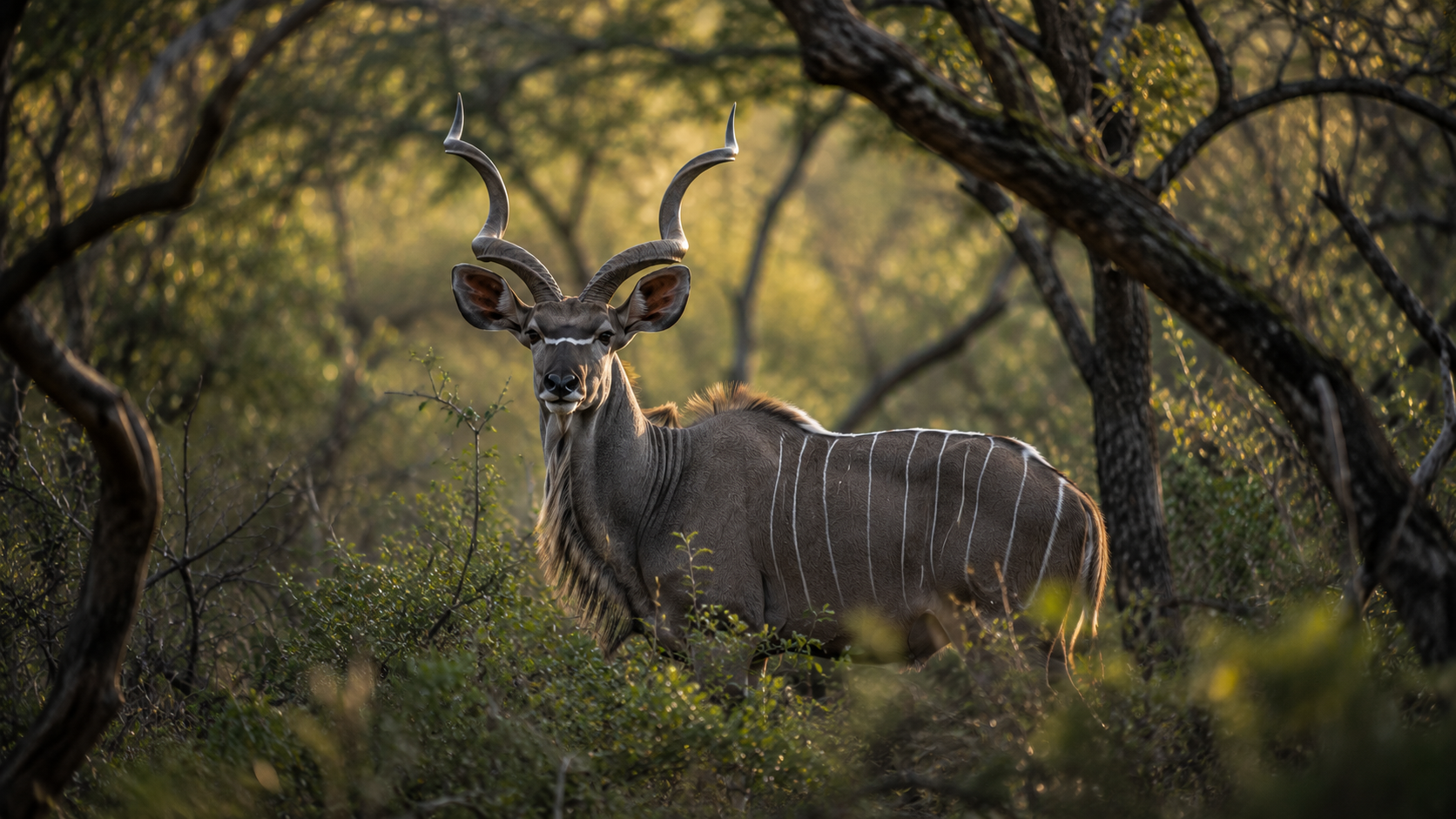
The kudu’s nickname sounds dramatic, but once you have seen one in the bush, it makes perfect sense. The phrase “Grey Ghost of Africa” is not a scientific label; it is a bush nickname shaped by the kudu’s grey-brown colouring, striped camouflage and uncanny habit of seeming to vanish into woodland just when you thought you had a clear view. African Wildlife Foundation notes that kudu markings help camouflage them, and that when alarmed they often stand still, making them very difficult to spot.
That talent for disappearance is part of what makes the greater kudu one of Africa’s most admired antelope. Even though it is a large animal, it rarely feels heavy in the landscape. In woodland and bushland, its narrow body, muted coat and pale vertical stripes break up its outline so effectively that a kudu can seem to dissolve into shadow, scrub and branches. This is one of the main reasons the “ghost” part of the nickname has endured for so long.
The “grey” part is just as easy to understand. Britannica describes the greater kudu as a grey or brownish antelope with elegant striping, while AWF highlights the cryptic colouring that protects it in wooded habitat. In the filtered light of thornveld, mopane or mixed bush, that soft, smoky colouring does not stand out; it blends. Instead of flashing through the veld like a bright-marked antelope, the kudu looks almost painted into the background.
The greater kudu also lives in exactly the kind of habitat that helps this illusion. AWF says greater kudu are found in woodlands and bushlands, where cover matters. These are not animals of wide, open plains by preference. They are creatures of edges, thickets, broken shade and layered vegetation — the sort of places where camouflage is not just useful but essential.
Their behaviour reinforces the nickname even more. Many animals flee first and disappear later. Kudu often do the opposite: they freeze. AWF notes that if alarmed, they usually stand still, which makes them extremely hard to spot. That stillness is powerful. A motionless kudu in dappled bush can be nearly invisible until an ear flicks, a tail moves or the animal steps forward and suddenly appears where nothing seemed to be a second earlier.
This is one reason kudu sightings feel so memorable on safari. You do not always “find” a kudu in the same straightforward way you might notice zebra in open grassland or giraffe above the tree line. Sometimes the kudu reveals itself gradually. First a horn tip. Then a stripe. Then the whole animal, standing there as though it had been watching you the entire time. That sense of delayed discovery has made the kudu legendary among guides, photographers and wildlife lovers alike. The nickname survives because it captures the experience of seeing one, not just the biology of the species.
Of course, the kudu would still be extraordinary even without the nickname. Britannica notes that males carry the longest horns of any antelope, typically around 120–180 cm along the curve, and those great spirals make bulls instantly recognisable. AWF also notes that kudus are browsers, feeding on leaves and shoots, and in dry seasons they may take fruit for moisture. So the kudu combines visual drama with quiet intelligence: a striking silhouette when exposed, and near invisibility when it chooses cover.
The nickname also reflects character. Kudu are not noisy, flashy animals. Their beauty is subtle. Their presence feels calm, watchful and alert rather than theatrical. That is why the “Grey Ghost” name feels more fitting than a grander title might. It reflects elegance, not aggression; mystery, not spectacle.
From a conservation point of view, the greater kudu remains in a relatively secure position compared with many African mammals. South Africa’s Red List assessment says the species is Least Concern in the regional assessment and remains widespread and abundant in the region, while IUCN search results also list the greater kudu as stable. That does not mean kudu face no local pressures, but it does mean the species still thrives across much of its range when habitat and management remain in place.
That stability is good news, because the kudu is one of those animals that gives African landscapes some of their deepest character. It is not only the size of the bull, the spiral horns or the beauty of the coat that people remember. It is the way the animal belongs to the bush. The way it seems to arrive and disappear without disturbance. The way an entire sighting can feel like a secret shared briefly and then taken back by the trees.
And that is why the kudu is called the Grey Ghost of Africa. Not because it is mythical, but because it so often feels unreal until the exact moment you see it clearly — and by then, it may already be slipping away again.
