
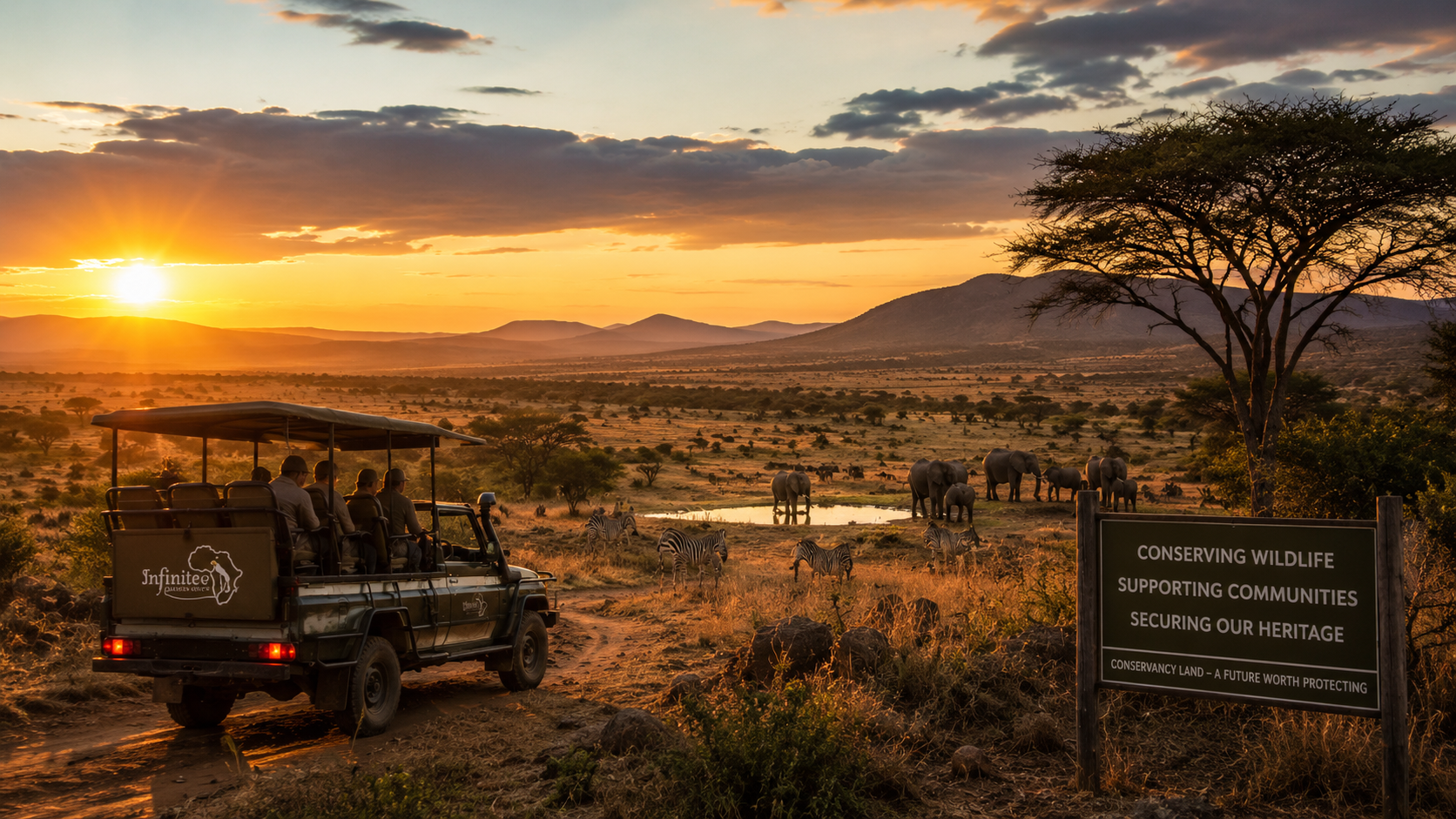
Most people can describe what they want from safari, even if they do not yet know the best words for it.
They want space.
They want time.
They want fewer vehicles at sightings.
They want the wildlife encounter to feel natural, not crowded.
They want the trip to feel good, not only for themselves, but for the place and people around it.
In many cases, what they are really asking for is a safari with a conservancy mindset.
Because one of the most important conversations in African travel right now is not only about where people go, but about how those places are protected, how tourism supports them, and how local communities benefit when wildlife remains valuable on living landscapes.
That is why conservancy-based safari has become such a compelling idea.
A different model of safari
Traditional national parks remain central to African conservation and safari travel. They protect extraordinary land and give millions of travellers access to wildlife every year. But private and community-linked conservancies offer something different.
They often feel quieter. More spacious. More deliberate.
Go2Africa’s 2026 explanation of national parks, game reserves and conservancies captures this difference clearly, describing conservancies as places where guests often enjoy fewer vehicles, more exclusivity and a more intimate safari experience, while still supporting conservation and nearby communities.
That distinction matters because modern safari travellers are increasingly looking for intimacy rather than volume.
They do not just want to see wildlife. They want to feel that the encounter belonged to the place and the moment, not to a queue of vehicles or a rushed tourism circuit.
Fewer vehicles, more atmosphere
One of the strongest practical advantages of a conservancy-style safari is simple: fewer people in the same space.
This changes everything.
The atmosphere at sightings feels calmer. Wildlife often appears less pressured. Guests feel they have more room to watch, photograph and absorb what is happening. The guide can work with patience rather than urgency.
Safari operators and destination specialists frequently highlight this exact advantage. Go2Africa’s private conservancy guidance notes the appeal of fewer vehicles and stronger exclusivity, while conservancy-focused safari writing in Kenya repeatedly points to low-density tourism as one of the defining features of the model.
For the traveller, that translates into something very valuable: a safari that feels less like a crowded attraction and more like an authentic experience in the wild.
Why conservancies matter beyond the guest experience
The deeper reason conservancy-based safari matters is not only what it gives the guest. It is what it can give the landscape.
Kenya’s Wildlife Conservancies Association states that conservancies in Kenya now cover more than 10.3 million hectares, directly affect the lives of 1 million households, and help secure 65% of Kenya’s wildlife found outside national parks and reserves.
That is a remarkable figure.
It means conservancies are not a niche add-on to African conservation. In some places, they are central to its future. A 2024 conservation science paper similarly found that as of 2023, Kenya had 230 wildlife conservancies covering 16% of the country’s land mass.
In Namibia, the communal conservancy model has also become one of Africa’s best-known examples of community-linked conservation. WWF describes these conservancies as helping to protect wildlife while generating income and supporting local people, and Namibia’s own conservation structures define communal conservancies as self-governed institutions with rights linked to wildlife use and management.
What this means in plain language is that safari, when linked to well-run conservancy systems, can help keep land open, wildlife valuable and rural livelihoods connected to conservation rather than pushed out by it.
Tourism matters because it creates value
This is where safari travellers have more influence than they often realise.
The World Bank has repeatedly highlighted the economic value of wildlife tourism in Africa, noting that nature-based tourism can create jobs, generate revenue and support local communities. Its 2025 work in South Africa similarly points to wildlife-linked tourism as a source of rural employment, local business growth and wider economic activity.
Research on private conservation funding also shows that wildlife tourism can contribute significant financial support to private reserves, communal conservancies and protected areas, including funding for protection, management and local employment.
That matters because safari is often spoken about only in emotional terms. The beauty. The wonder. The wildlife. All of that is real and important. But there is another side to the story: safari can help create a reason for land to remain wild.
And in places where land pressure, development or competing land uses are intensifying, that reason matters enormously.
Why this feels relevant to today’s traveller
Modern travellers are increasingly asking ethical questions.
They want to know whether a trip is meaningful. Whether the destination benefits. Whether their money disappears into a tourism machine or reaches people and places in a more grounded way.
That is one reason community-linked and conservation-linked travel continues to gain attention. Travel brands and market reports repeatedly show stronger demand for authentic, responsible and more values-driven travel.
Conservancy safaris fit naturally into that shift.
They allow a traveller to enjoy beauty and exclusivity while also knowing that the safari exists within a larger conservation and community context. That does not mean every conservancy is perfect or every model is identical. Some work better than others, and benefit-sharing remains an important real-world issue. A 2025 tourism study in Namibia, for example, stresses that wildlife tourism in communal conservancies has strong potential for rural development, but that outcomes depend on fair and equitable benefit-sharing.
That nuance is important.
A conservancy is not automatically “good” simply because it carries the word. But when it is well-run, transparent and properly linked to local livelihoods, it can be one of the most meaningful ways to experience safari today.
The safari experience becomes richer too
The beauty of conservancy safari is that it improves both the visible and the invisible parts of travel.
The visible part is obvious. Fewer vehicles. More room. A more intimate atmosphere. Often more flexible activities depending on where you are, such as walking, night drives or off-road interpretation within the rules of the conservancy. Safari writing on conservancies frequently points out that these experiences can feel more immersive precisely because the land is managed differently from a heavily trafficked public reserve.
The invisible part is just as important.
It is the feeling that the safari sits inside a larger story. That the place has a future because people around it have reasons to value that future. That the trip is not only consuming nature, but helping sustain it.
That depth changes how a guest remembers a safari.
Why this matters for Infinite Safaris Africa
For a safari brand, conservancy thinking is powerful because it speaks to where the market is moving.
Guests want more intimacy. More authenticity. More meaningful travel. More connection to place. More confidence that the safari they choose is worth it in every sense, not only in the visual one.
Conservancy-linked or conservancy-inspired storytelling helps answer those needs.
It allows a brand to speak not only about wildlife, but about stewardship. Not only about sightings, but about space. Not only about travel, but about what travel helps make possible.
That kind of message feels particularly strong in 2026, because the safari traveller is not becoming less interested in Africa. If anything, they are becoming more selective about how they want to experience it.
And that creates a real opportunity.
Because the safari that feels quieter, more spacious, more thoughtful and more rooted in conservation is increasingly the safari people remember most.
