
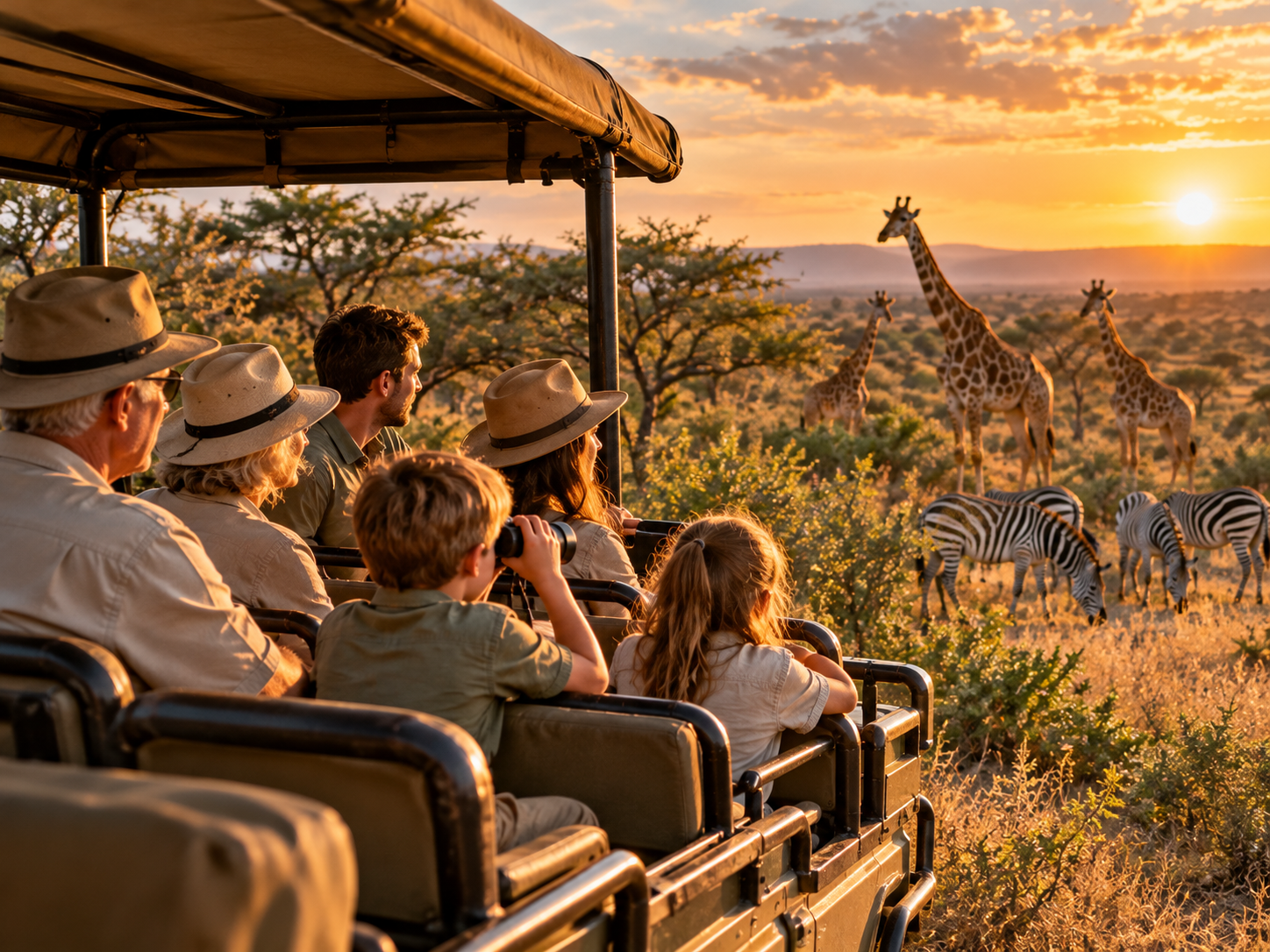
From a child’s first giraffe sighting to a grandparent’s long-awaited return to Africa, some journeys are simply better when shared.
At six years old, the most exciting part of an African safari might be discovering a tiny animal track in the sand.
At sixteen, it might be photographing a giraffe silhouetted against an enormous African sunset.
At forty-five, it could be the rare pleasure of watching the entire family enjoy something together without phones, deadlines or the usual demands of everyday life.
And at seventy, perhaps the greatest reward is looking around the dinner table and realising that three generations are sharing an experience none of them will ever forget.
This is the beauty of a family safari in South Africa.
It is not a holiday where everyone needs to enjoy exactly the same thing. It is a journey where different ages, personalities and interests come together through a shared experience of Africa.
And in 2026, this kind of travel is attracting increasing attention.
More families are looking beyond traditional beach holidays and city breaks in search of something memorable, meaningful and suitable for several generations.
For Infinite Safaris Africa, family travel represents everything that makes a safari special: wildlife, adventure, beautiful accommodation, time together and stories that become part of a family’s history.
Why Multigenerational Safaris Are Gaining Attention
The idea of travelling with grandparents, parents and children is not new.
What is changing is the way families are approaching these holidays.
Rather than arranging several smaller trips for different family members, some are choosing a single memorable journey that brings everyone together.
Recent safari-industry reporting reflects this development.
In September 2026, safari operator Safari.com published an analysis of its own bookings showing that three-generation travel parties had increased in its customer base. The company also reported greater representation of older travellers in recent bookings and growing interest in accommodation designed for larger families.
These figures relate to that operator’s bookings rather than the entire African safari market, but they provide an interesting indication of how family travel preferences are developing.
There is a practical reason why this makes sense.
A safari can be enjoyed in different ways.
Children may be fascinated by animals they have previously seen only in books. Teenagers may enjoy photography, adventure and learning about wildlife behaviour. Parents may value comfortable accommodation and well-organised activities. Grandparents may appreciate scenic drives, beautiful landscapes, relaxed hospitality and time spent with their families.
The same African landscape can offer something different to everyone.
That is what makes a multigenerational safari such an attractive travel experience.
The First Wildlife Sighting Is Often the Most Memorable
Imagine a family setting out on a morning game drive.
The vehicle moves slowly along a sandy track while the sun begins to rise over the bushveld.
A guide points towards a movement between two trees.
At first, nobody sees anything.
Then a giraffe steps into the open.
For an experienced safari traveller, giraffes may be a familiar sight. But for a child experiencing Africa for the first time, the moment can feel almost unbelievable.
The animal is taller, more graceful and more extraordinary than any photograph suggested.
And suddenly, the adults in the vehicle are enjoying the sighting through the child’s excitement as much as through their own eyes.
That is something remarkable about family safaris.
They allow familiar experiences to become new again.
Wildlife has a way of crossing generational boundaries. An elephant does not need an explanation to inspire wonder. A zebra foal can capture the attention of almost anyone. A kudu emerging from woodland can turn a quiet drive into a moment everyone remembers.
The experience belongs to the entire family, even when each person remembers it differently.
A Safari Is One of the Few Holidays Where Different Ages Can Enjoy the Same Moment
Many holidays require compromises.
One person wants adventure. Another wants relaxation. Someone prefers photography, while someone else wants time beside a swimming pool.
On a well-planned African safari, those interests can exist alongside one another.
Families can enjoy shared wildlife experiences without making every activity compulsory for everyone.
A morning might begin with a guided wildlife outing. Later, some guests may want to relax at the lodge while others review photographs or enjoy an arranged activity.
In the afternoon, the family can gather again for a meal, a scenic drive or quiet time outdoors.
The important thing is flexibility.
A safari planned for three generations should never feel like a school timetable. Nor should it expect younger children to endure long activities simply because adults enjoy them.
The best experiences allow the day to unfold at a pace that works for the people travelling.
That balance is particularly important for families who want the excitement of Africa without sacrificing comfort.
Why South Africa Is Such a Strong Family Safari Destination
South Africa offers an appealing combination of wildlife, scenic diversity, accommodation options and travel infrastructure.
Visitors can choose between different safari regions, from bushveld and open plains to national parks, private reserves and semi-arid landscapes.
This variety makes it possible to build itineraries around the needs of individual families.
Some families want traditional Big Five game viewing. Others prefer photographic safaris, birdlife, plains game, beautiful accommodation and a quieter bushveld experience.
For families travelling with young children, older relatives or members who prefer shorter activity periods, the right destination can make an enormous difference.
Travel time matters. Climate matters. The style of accommodation matters. So does access to suitable activities.
It is not simply a question of choosing the most famous national park.
It is about choosing somewhere everyone can enjoy.
South Africa also offers safari destinations outside the main malaria-risk regions, an important consideration for some family groups. However, malaria risks differ by location, and travellers should seek current destination-specific medical advice before departure.
The right itinerary combines wildlife ambitions with practical comfort.
Loskop Farm: A Place for Shared Safari Experiences
For Infinite Safaris Africa, Loskop Farm offers a distinctive base from which to introduce families to the South African bush.
Located in the Boshof district of the Free State, near Kimberley, the property forms an important part of Infinite Safaris Africa’s identity.
Its accommodation, open landscapes and personalised safari approach provide a setting where guests can enjoy both outdoor experiences and time together.
The company’s existing family safari offering is designed to accommodate different interests, including guests who are not participating in hunting activities.
This is particularly important for mixed groups.
Perhaps one family member is interested in hunting, while others prefer wildlife photography, scenic experiences, lodge activities or simply enjoying the atmosphere of the bush.
A good safari plan does not force everyone into the same activity.
Instead, it creates opportunities for the family to enjoy time together while allowing individuals to follow suitable interests.
At Loskop Farm, guests can discuss family accommodation, available activities, children’s arrangements and personalised itineraries with the Infinite Safaris team before making a booking.
That planning process is important because the best family experience is one that considers everyone’s needs from the beginning.
Children See Africa Differently — and That Is Part of the Magic
Children often notice things that adults overlook.
An adult may be searching the horizon for a large animal, while a child notices a brightly coloured bird on a branch.
A guide may be explaining the habits of a giraffe, while someone younger becomes fascinated by the shape of an animal’s footprint.
For children, the bush is full of questions.
Why do zebras have stripes?
How does a giraffe drink water with such a long neck?
Why do some animals have horns and others have tusks?
How do birds know where to build their nests?
Why does an elephant use its trunk?
These questions are not interruptions to the safari. They are part of what makes it so valuable.
A good guide can use simple observations to introduce children to ecology, wildlife behaviour and the natural world.
Instead of learning only from screens or books, they begin connecting information with real animals and landscapes.
A zebra is no longer merely an illustration. It becomes an animal with behaviour, family relationships and a place within the ecosystem.
An antelope track becomes evidence of movement.
A bird call becomes something worth listening for.
The landscape starts telling a story.
And long after the holiday ends, these small discoveries can continue inspiring curiosity.
For Teenagers, Safari Offers a Different Kind of Adventure
Teenagers sometimes require a different approach to family holidays.
They may be less interested in traditional sightseeing but enthusiastic about photography, technology, adventure and wildlife.
An African safari offers opportunities to connect these interests with the outdoors.
Photography is particularly appealing.
A teenager with a camera or smartphone can begin experimenting with composition, light, wildlife movement and storytelling.
The challenge becomes more than simply taking photographs.
It is about noticing behaviour, anticipating an interesting moment and learning to observe without disturbing the animals.
A photograph of an elephant standing beside water may become a favourite image. A dramatic cloud formation over the veld may be equally memorable.
For young people interested in the environment, a safari also provides opportunities to learn about conservation, natural habitats and the relationships between species.
These experiences can be enjoyable without feeling like a formal lesson.
And for parents, watching a teenager become genuinely absorbed in the natural world can be one of the most rewarding parts of the trip.
Grandparents Bring Something Special to a Family Safari
There is a particular beauty in travelling with grandparents.
They bring stories, patience and a different perspective on time.
Some may have travelled through Africa before and be returning to familiar landscapes. Others may be experiencing their first safari later in life.
Either way, their presence can give the journey a deeper meaning.
A grandparent sharing a wildlife sighting with a grandchild creates a memory that belongs to both of them.
The child may remember the animal.
The grandparent may remember the expression on the child’s face.
Both will remember being there together.
For older travellers, practical comfort deserves careful attention.
An itinerary should consider mobility, suitable vehicle access, accommodation arrangements, travel distances, medical requirements and how much time guests want to spend outdoors.
Not everyone needs to participate in every activity.
There should be enough flexibility for some people to rest while others explore.
A safari designed around the whole family can make room for those differences without anyone feeling excluded.
The Best Family Safari Is Not the Busiest One
One of the most common mistakes in travel planning is assuming that more activities automatically create a better holiday.
On safari, that is rarely the case.
An itinerary packed with transfers, excursions and early starts may sound exciting on paper, but it can become exhausting for families travelling with children or older relatives.
The bush is best enjoyed with time to appreciate it.
A well-balanced family safari allows space for shared meals, quiet afternoons, stories, photography and spontaneous moments.
Sometimes the highlight of the day is a wildlife sighting.
Sometimes it is a beautiful lunch outdoors.
Sometimes it is watching the sunset together from the lodge.
And sometimes it is simply having a conversation that would never have happened during an ordinary week at home.
Those quieter moments are not wasted time.
They are often where the holiday becomes a family memory.
Choosing the Right Activities for Every Age
Not every safari activity is suitable for every traveller.
This is particularly important where young children are involved.
National parks and private reserves may have different minimum-age requirements for guided drives, walking experiences and other activities.
For example, SANParks currently states that children under six are not permitted on its organised Kruger National Park game drives. Guided walks in Kruger have a minimum age of twelve.
These restrictions are important reminders that wildlife activities require appropriate safety procedures.
Parents should therefore confirm exactly which experiences children are allowed to participate in before booking.
The same principle applies to older travellers and guests with mobility requirements.
A family itinerary should be designed around genuine suitability rather than assuming that every activity will work for everyone.
When discussing a family safari, it helps to provide the operator with the ages of children, mobility considerations and the group’s preferred activity level.
That information allows the outfitter to recommend realistic options.
Where Else Can Families Enjoy an African Safari?
One of Infinite Safaris Africa’s strengths is the ability to discuss safari experiences across several African destinations.
Different countries offer different landscapes, wildlife and travel styles.
South Africa provides a wide selection of national parks, private reserves, scenic routes and family accommodation options. It can be an excellent introduction to African wildlife.
Botswana is renowned for its waterways, elephants and remarkable wilderness areas. It can be particularly appealing to families interested in wildlife photography and nature-based experiences, although remote travel and activity restrictions need careful consideration.
Namibia offers dramatic desert landscapes, open skies and fascinating wildlife adapted to arid environments. Its scenic diversity can appeal to families who enjoy landscapes as much as animal sightings.
Zimbabwe combines wildlife destinations such as Hwange National Park with the famous scenery of Victoria Falls, making it possible to consider different types of experiences within one journey.
Zambia is known for its river systems and wildlife-rich national parks. Families with older children may find its more adventurous safari environments especially appealing, subject to operator-specific requirements.
Mozambique offers a combination of natural landscapes, wildlife areas and coastal destinations that can add a different dimension to a broader African holiday.
Tanzania, in East Africa, provides memorable wildlife viewing in regions such as the Serengeti and Ngorongoro Conservation Area, together with other scenic and coastal experiences.
Not every destination or activity is suitable for every family.
Some require longer travel days, additional health precautions or specific age restrictions. A carefully planned itinerary should account for these considerations before reservations are made.
That is why personalised planning is so valuable.
Planning a Family Safari: The Details That Make a Difference
The difference between a stressful family trip and a memorable one often comes down to the planning.
Before choosing accommodation or finalising travel dates, families should consider:
- The ages of all travellers: Activities should be appropriate for children, teenagers and older relatives.
- Travel distances: Long road transfers and multiple connecting flights can be tiring.
- Accommodation: Confirm room layouts, occupancy limits, shared spaces and family-friendly facilities.
- Activity restrictions: Check minimum ages, fitness requirements and accessibility.
- Weather: Choose a travel season that suits the group’s comfort and wildlife interests.
- Health requirements: Obtain professional advice about vaccinations, malaria prevention and individual medical needs.
- Travel documentation: Confirm passports, visas and documentation requirements for children, especially when travelling internationally.
- Time together: Leave room for rest, shared meals and unplanned moments.
For international visitors, these details deserve particular attention.
Families travelling with children should check the latest entry requirements for every country in their itinerary. Rules concerning minors, consent documentation and passports may differ depending on nationality and travel arrangements.
They should also obtain suitable travel insurance and discuss destination-specific medical precautions with a qualified healthcare professional.
Good preparation removes uncertainty and allows the family to enjoy the experience once they arrive.
The Moments Nobody Can Put on an Itinerary
Perhaps the most beautiful part of a family safari is that the best memories cannot always be planned.
You can arrange the accommodation.
You can book the vehicles.
You can select the destination, activities and travel dates.
But you cannot schedule the exact moment a child notices a giraffe looking directly towards the vehicle.
You cannot predict the conversation that will begin around a dinner table after an extraordinary day.
You cannot plan the sound of everyone laughing together over something that happened during a drive.
And you certainly cannot guarantee the wildlife encounter that becomes the family’s favourite story.
That unpredictability is part of the experience.
A safari gives families a shared adventure, but each person returns home carrying something slightly different.
A photograph. A sound. A sighting. A conversation. A feeling.
Together, those memories become the story of the trip.
An African Safari Can Become Part of Your Family Heritage
Family heritage is often associated with photographs, traditions and stories passed between generations.
An African safari can become part of that heritage.
For grandparents, it may be the satisfaction of sharing an extraordinary destination with their children and grandchildren.
For parents, it may be the joy of seeing everyone together.
For children, it may be their first meaningful encounter with the natural world.
Years later, the family may not remember every detail of the itinerary. They may forget the name of a road or the exact time of a game drive.
But they will remember the feeling of being together.
They will remember the light.
They will remember the animals.
And they will remember the people who shared those moments with them.
That is what makes a multigenerational safari so special.
Frequently Asked Questions
Is South Africa suitable for a family safari?
Yes. South Africa offers many wildlife destinations and accommodation styles suitable for family travel. The best choice depends on children’s ages, travel distances, health considerations and individual activity requirements.
What is the best age to take children on an African safari?
There is no single ideal age. Many children can enjoy age-appropriate wildlife experiences, but game-drive and walking-safari restrictions differ between parks and lodges. Families should confirm these before booking.
Can grandparents and young children travel together on safari?
Yes, provided the itinerary considers each traveller’s health, mobility, comfort and interests. Appropriate accommodation and flexible activity schedules are particularly important.
Can a family enjoy a safari if everyone has different interests?
Absolutely. A personalised itinerary can include shared wildlife experiences alongside suitable individual activities, relaxation and photography opportunities, subject to availability and age restrictions.
Let Your Family’s Next Story Begin in Africa
At Infinite Safaris Africa, we believe a safari should reflect the people taking part in it.
Some families want wildlife photography. Others prefer relaxed days at a beautiful lodge. Some want adventure, while others are simply looking for time together in an extraordinary natural setting.
Whatever your family’s interests, the right safari begins with careful planning and an understanding of what matters to everyone.
Whether you are arranging a holiday for parents and children, travelling with grandparents or bringing several generations together for a special occasion, we would love to discuss the possibilities.
Tell us who will be travelling, what you would love to experience and when you hope to visit Africa.
We can help you explore a safari itinerary designed around your family.
Because the greatest journeys are not always the ones we take alone.
Sometimes they are the ones we share.
Infinite Safaris Africa — Become part of our great safari heritage.
