
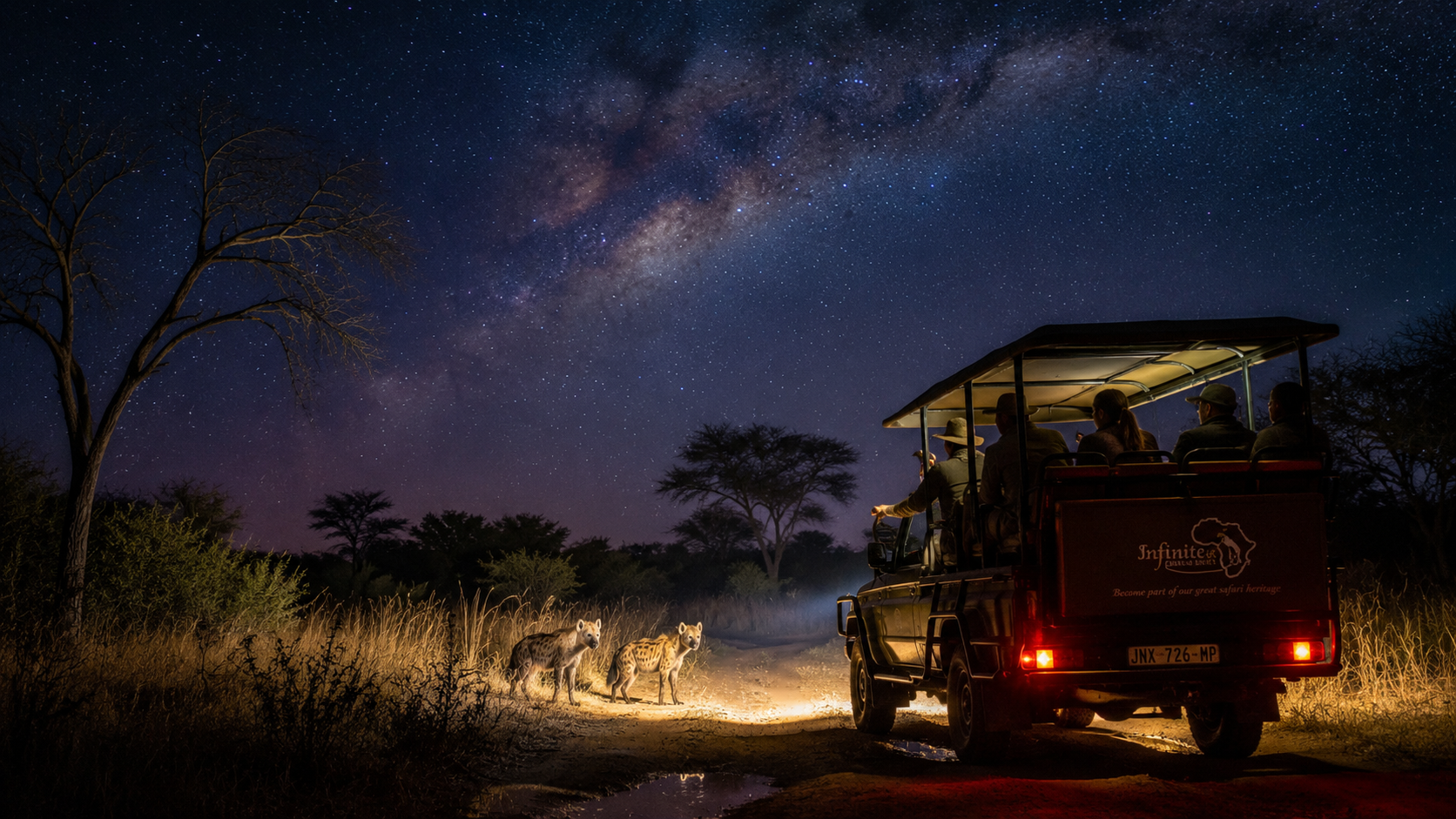
There is a moment on safari when the light drains out of the land and everything begins to feel slightly different.
The familiar shapes are still there — the trees, the tracks, the outline of the grass — but the bush is no longer the same place it was an hour before. The air cools. Sounds sharpen. Distances seem to shorten. Things that felt visible begin to disappear, and other things, hidden all day, begin to emerge.
This is the hour many safari travellers never truly get to know.
For years, the classic safari day has been shaped around sunrise and sunset, with the middle hours softened by rest, meals and lodge life. That rhythm still holds enormous charm. But something is changing. Across global travel, and increasingly in Africa, travellers are showing growing interest in what happens after dark. National Geographic describes this as the rise of noctourism, a growing travel movement focused on nighttime experiences, from stargazing to after-dark wildlife encounters. The same report notes that in a Booking.com survey, 62% of respondents across 33 countries said they were considering trips with experiences at night, while one luxury tour operator reported nocturnal excursions were up 25% in 2024.
That trend matters because Africa may be one of the best places on earth to understand why the night is so compelling.
The safari most people do not see
Daytime safari is extraordinary. It gives you scale, beauty, colour and some of the continent’s most iconic wildlife moments. But the bush after dark belongs to a different cast of characters.
At night, the land becomes quieter in one way and more alive in another. Predators move differently. Smaller mammals begin to take their turn. Birds become voices in the darkness rather than shapes in the sky. The world of spotlight eyeshine, rustling grass and distant calls creates a very different kind of safari memory.
National Geographic’s 2026 reporting on Africa’s after-dark safari trend highlights exactly this appeal, noting the growing interest in nocturnal safaris across the continent and the fact that night experiences reveal wildlife most travellers never see during the day.
And it is not only wildlife that changes.
The sky changes too.
In countries like South Africa and Namibia, darkness itself has become a travel asset. A 2025 South African research study on astrotourism in national parks found clear evidence of demand for dark-sky experiences and noted that travellers preferred these to feel authentic, low-impact and not over-commercialised.
That description could almost be a definition of safari at its best.
Why after-dark experiences feel more personal
One reason night safaris are becoming so appealing is that they naturally create a different emotional tone.
A daytime game drive often feels expansive. There is light everywhere. The horizon is wide. The experience is shared openly with the landscape. Night safari is more intimate. It narrows the world down. You pay closer attention. You listen harder. You become more aware of the guide, the sounds, the movement and the atmosphere around you.
In many ways, it is a more immersive form of safari.
That matters in a travel market where people are increasingly seeking more meaningful and more personalised experiences. Current safari trend reporting points to stronger demand for slower, more immersive journeys that go beyond the standard game drive and include experiences like stargazing, hide photography and bush walks.
Night safari fits perfectly into that shift.
It does not replace the classic safari. It deepens it.
The thrill of what you cannot predict
One of the things that makes night safari so memorable is that it resists predictability.
During the day, many guests arrive with a rough mental map of what they hope to see. Elephants, giraffes, lions, zebra, antelope. The expectations are familiar. At night, the experience becomes more open-ended. A genet crossing the road can feel just as thrilling as a predator sighting. A springhare in the beam of a light can become a highlight because it belongs so completely to the night. A distant hyena call can shape the mood of an entire evening.
Africa Geographic’s writing on nocturnal species in Africa captures this beautifully, emphasising that experiencing nocturnal animals is one of the great highlights of the safari world precisely because so many of these creatures remain secretive and rarely seen in daylight.
That unpredictability is part of the charm.
It asks less of the checklist mindset and more of the traveller’s curiosity.
Night safari is not only about wildlife
There is another reason after-dark safari is resonating with travellers, and it has nothing to do with animals at all.
It is about atmosphere.
It is about the feeling of standing under a sky thick with stars and realising how little artificial light shapes your world in that moment. It is about hearing the veld instead of only looking at it. It is about campfires, lantern light, night air and the kind of stillness that modern life offers very rarely.
This is where night safari and dark-sky travel begin to overlap.
South Africa’s national astrotourism strategy and the 2025 study on astrotourism in South African national parks both point to real opportunity in dark-sky tourism, particularly for travellers seeking authentic, nature-based experiences that connect them to place.
For safari travellers, that creates a new kind of itinerary logic. A day in the bush no longer has to end at sunset. It can continue into stargazing, night drives, fireside storytelling and low-light photography. The journey becomes fuller without needing to become busier.
Why this matters for modern safari brands
For safari operators, the rise of after-dark travel is more than a trend to mention casually. It is a real content and experience opportunity.
Travellers are showing stronger interest in specialist experiences, and after-dark safari offers exactly that. It provides a fresh angle for people who have already done a traditional safari. It offers photographers new subject matter. It gives couples and families a deeper sense of immersion. It helps safari feel less like a standard tourism product and more like a layered, lived experience.
This is especially valuable for brands like Infinite Safaris Africa, where storytelling and atmosphere matter just as much as destination lists.
Because the best way to sell a safari in 2026 is not simply to say, “We offer game drives.”
It is to show people what the bush feels like when the day ends and the real night begins.
The future of safari may be quieter, darker and even more beautiful
Travel trends often become overused words very quickly. But some trends last because they reflect something real in the way people want to travel.
Noctourism looks like one of those.
It makes sense in a world where people are overstimulated, over-lit and too often disconnected from nature’s true rhythms. The appeal of darkness, stars, nocturnal wildlife and after-hours stillness is not artificial. It is deeply human.
And in Africa, it can be extraordinary.
So yes, the classic sunrise safari will always deserve its place. But increasingly, the traveller who wants the fullest safari story is also beginning to ask what happens after sunset.
The answer, in the right place, is: quite a lot.
And much of it is unforgettable.
