
As Southern Africa welcomes the summer months, one of the natural world’s most remarkable long-distance travellers begins arriving from the other side of the planet.
Imagine standing beside an open grassland in Southern Africa on a warm November afternoon.
The first summer clouds are gathering on the horizon. Insects move through the grass, and the air carries the promise of rain.
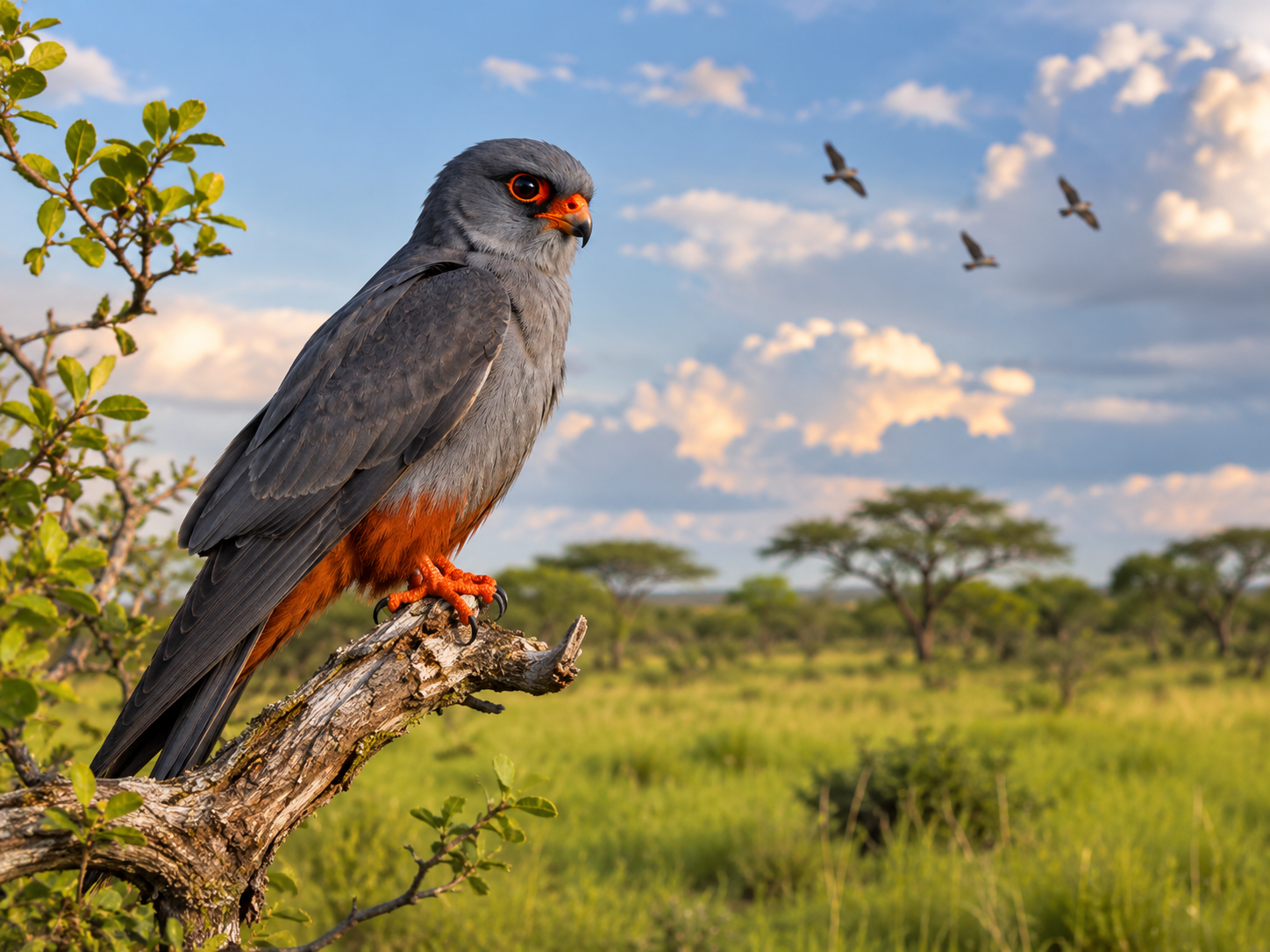
A small bird lands on a branch above the field.
It is not particularly large. Its wings are narrow and pointed, its eyes alert, and its posture unmistakably that of a falcon.
To someone unfamiliar with the species, it might look like an ordinary bird of prey.
But this little visitor has an extraordinary story.
It may have travelled thousands of kilometres from its breeding grounds in eastern Asia, crossed mountains, forests and open water, and passed through several countries before reaching Southern Africa.
It is the Amur falcon.
And in October 2026, new reports from a satellite-tracking project provided another fascinating reminder of just how remarkable these birds are.
While the world’s attention often falls on Africa’s lions, elephants and giraffes, an extraordinary wildlife migration takes place above the landscape almost unnoticed.
For travellers interested in birds, photography and the hidden wonders of the natural world, the arrival of the Amur falcon is one of the most fascinating stories of the Southern African summer.
A Small Falcon With an Extraordinary Journey
The Amur falcon (Falco amurensis) is a small migratory bird of prey.
It breeds across parts of eastern Russia, northeastern China and surrounding regions of East Asia.
But when the Northern Hemisphere moves towards winter, these birds begin one of the most extraordinary migrations undertaken by any small raptor.
Their destination is Southern Africa.
The journey can cover approximately 11,000 kilometres in one direction, although actual distances vary depending on the route taken.
For perspective, that is a journey spanning continents, climates, landscapes and vast stretches of ocean.
And the birds accomplish it using little more than their wings, natural instincts and access to suitable feeding and resting opportunities along the way.
They do not travel with maps.
They do not know about international borders.
They follow a seasonal rhythm that has developed over countless generations.
It is a remarkable reminder that Africa’s wildlife stories reach far beyond the boundaries of its national parks.
October 2026: New Tracking Reports Reveal an Astonishing Journey
One of the reasons this story is particularly exciting right now is the continuing progress of satellite-tracking research.
On 23 October 2026, Indian news outlets reported that two satellite-tagged Amur falcons, named Apapang and Alang, had returned to a migratory staging area in Manipur, northeastern India.
The birds had been fitted with satellite transmitters in November 2025 as part of a monitoring project involving India’s Wildlife Institute and local wildlife authorities.
According to the October reports, their tracked annual journeys had taken them through 23 countries and covered approximately 20,000 kilometres.
That is an extraordinary distance for birds of such modest size.
During the 2025–2026 migration cycle, tracking reports had also recorded these falcons in Africa.
In February 2026, Apapang was reported in Zimbabwe, while Alang was reported in Botswana.
A third tagged falcon, Ahu, was reported in Somalia at the same time.
These are individual tracking observations rather than proof that every Amur falcon follows exactly the same route.
Nevertheless, they provide a wonderful real-world example of how birds connect distant ecosystems.
A falcon observed in Southern Africa may have spent months travelling through regions that most people will never visit in a lifetime.
And after reaching the African continent, it must eventually make another long journey north.
A Journey That Begins in the Far East
The Amur falcon’s annual movement begins in its northern breeding range.
During the Northern Hemisphere’s warmer months, the birds breed in parts of eastern Asia.
As the seasons change, they begin their southward journey.
Many pass through northeastern India, where large gatherings of migrating Amur falcons are well documented.
For some individuals, these staging areas provide important opportunities to rest and feed before continuing towards Africa.
From the Indian subcontinent, the route becomes particularly remarkable.
Tracked birds have crossed the Arabian Sea towards the Horn of Africa, before moving farther south across the continent.
Studies of satellite-tagged Amur falcons have documented ocean crossings of approximately 3,000 kilometres.
Imagine what that means for such a small bird.
For a considerable period, the falcon must continue its flight over open water without the familiar resting places and feeding opportunities available on land.
Weather and wind conditions become important influences on the journey.
The bird must survive an immense physical challenge before it can continue towards its non-breeding grounds.
These journeys are so extraordinary that scientists use satellite transmitters and other monitoring methods to investigate how the birds travel.
Every successful migration adds another piece to our understanding of their remarkable abilities.
Why Do Amur Falcons Come to Southern Africa?
The answer lies in the seasonal availability of suitable conditions and food.
While their breeding grounds experience the colder months of the Northern Hemisphere, Southern Africa moves into its warmer summer season.
Across many regions, summer rainfall transforms grasslands and savannas.
Plants begin growing more actively. Insects become abundant. Termites emerge after suitable weather conditions, and flying insects provide feeding opportunities for numerous bird species.
For the Amur falcon, this seasonal abundance is important.
These birds feed predominantly on insects and other arthropods.
Their diet includes grasshoppers, locusts, beetles and flying termites.
They may perch above open ground while searching for food or hunt insects in flight.
An Amur falcon feeding above a grassland may therefore be taking advantage of the same seasonal changes that make Southern Africa’s summer landscapes feel so alive.
The bird’s migration is not simply a movement away from cold weather.
It is part of a remarkable annual cycle connecting breeding habitats in Asia with feeding habitats in Africa.
The Incredible Sight of Falcon Flocks
One of the most striking characteristics of the Amur falcon is its social behaviour outside the breeding season.
Amur falcons can gather in large groups, particularly at communal roosting sites.
In suitable areas, their evening gatherings may number thousands of birds.
During the day, they disperse to search for food, often across open grasslands and agricultural landscapes.
As evening approaches, birds may return towards communal roosts.
For wildlife observers, this behaviour can create a remarkable spectacle.
Imagine the sky filling with small falcons returning from a day’s feeding.
Some circle overhead. Others settle in trees. More continue arriving as the light begins to fade.
It is an entirely different kind of wildlife experience from watching a lion beside a waterhole or an elephant moving through the bush.
Yet it can be every bit as captivating.
The excitement lies in the movement, the scale and the knowledge of how far these small birds have travelled.
Wildlife fact: Not every Amur falcon spends the summer in the same place. Records show that the species occurs across several Southern African countries, with concentrations varying by habitat, season and year.
How to Recognise an Amur Falcon
Identifying an Amur falcon can be an enjoyable challenge for birdwatchers and wildlife photographers.
The species is relatively small, with long, pointed wings and a streamlined body.
Adult males typically display grey upperparts, pale underwing coverts, reddish markings around the lower body and distinctive reddish-orange bare parts around the eyes, bill base and feet.
Females have a different appearance, with more prominent streaking and barring across parts of their plumage.
Young birds can also look different from adults.
These variations make accurate identification particularly interesting.
Amur falcons may resemble other small migratory raptors, including red-footed falcons, and distinguishing them can require careful observation.
For anyone new to African birdwatching, an experienced bird guide and a good field guide can make the experience far more rewarding.
The important thing is not to identify every bird immediately.
It is to become curious enough to look again.
The Summer Landscape Comes Alive With Migratory Birds
The arrival of Amur falcons forms part of a much larger seasonal transformation across Southern Africa.
As spring moves towards summer, the birdlife changes.
Different migratory species begin arriving from Europe, Asia or elsewhere within Africa.
Some are remarkable long-distance travellers. Others move between African regions in response to seasonal changes.
The European bee-eater introduces bright colour and its distinctive calls to the landscape.
Barn swallows sweep across fields and water while searching for insects.
Woodland kingfishers, which migrate within Africa, announce their presence with their unmistakable trilling calls in suitable woodland habitats.
Cuckoos become more vocal in many areas, while summer raptors add further variety to the skies.
The timing of these arrivals differs between species and regions.
Some birds return relatively early in spring. Others become more noticeable later in October, November or December.
In the Lowveld, for example, the arrival of the woodland kingfisher is often associated with the return of summer.
For visitors who have previously experienced only the dry-season safari landscape, this can feel like discovering an entirely new Africa.
There is more birdsong.
More movement above the grass.
More colour among the trees.
And more opportunities to photograph wildlife beyond the famous large mammals.
Birdwatching in Africa Is About More Than Collecting Species
For many people, birdwatching begins with a simple list.
They hope to see a particular number of species or find a bird they have never encountered before.
But something changes once they begin paying closer attention.
A bird is no longer merely another name on a checklist.
It becomes an individual animal with behaviour, movement, habitat and an extraordinary natural history.
The Amur falcon is a perfect example.
You might spend only a few minutes watching one perched above a field.
Yet knowing that it may have travelled from the other side of the world completely changes the experience.
That bird has crossed landscapes that you may never see.
It has navigated changing seasons and weather systems.
It has survived an immense journey.
And now, for a brief part of the year, your paths have crossed in Africa.
That is what makes wildlife observation so rewarding.
The more you know, the more extraordinary an ordinary sighting becomes.
Where Can You See Amur Falcons in Southern Africa?
Amur falcons occur across suitable parts of Southern Africa during the non-breeding season, although their abundance differs considerably between regions.
South Africa: The species is most regularly associated with parts of the country’s eastern half, especially open grasslands, agricultural landscapes and suitable savanna habitats.
Botswana: Amur falcons occur in suitable open habitats, and satellite-tracking reports have confirmed individual birds spending part of the 2025–2026 season in the country.
Zimbabwe: Zimbabwe also falls within the species’ Southern African non-breeding range. One of the satellite-tagged falcons was reported there in February 2026.
Mozambique: Northern parts of the country form part of the species’ broader distribution in Southern Africa.
Zambia: Amur falcons occur in suitable areas, including parts of the country’s south-western region.
Namibia: The species is generally less widespread and is regarded as scarce in parts of northern Namibia compared with some other Southern African regions.
These are broad distribution patterns, not guarantees of sightings at individual lodges or national parks.
The most suitable locations can depend on recent weather, insect activity, migration timing and local observations.
For a photographic safari specifically focused on migratory birds, it is worth checking recent sighting records before finalising a route.
This is one reason bird-focused itineraries benefit from specialised local knowledge.
Why November Is Such an Interesting Time
In Southern Africa, November is often a period of transition towards wetter and warmer conditions.
Amur falcons begin reaching parts of the region around November, with some arrivals occurring later depending on location and the migration season.
That creates a fascinating time for wildlife photographers.
The arrival of migrants coincides with changing vegetation, growing insect activity and the return of other summer bird species.
But it is important to understand that November is not a guarantee of enormous falcon gatherings.
Some regions may see early arrivals, while others may experience stronger concentrations later in the season.
The best photography opportunities depend on being in suitable habitat when the birds are present.
That makes a well-informed, flexible itinerary particularly valuable.
For travellers interested in the full diversity of African wildlife, the warmer months can offer a very different experience from the dry season.
Instead of concentrating only on large mammals, guests can explore the colourful and energetic side of Africa’s birdlife.
Photographing Amur Falcons Without Disturbing Them
Small birds of prey offer beautiful photographic opportunities, but they require patience.
A long focal-length lens can be useful for photographing birds while maintaining a respectful distance.
Binoculars allow observers to identify interesting behaviour before deciding whether to raise the camera.
The best images often come from understanding where birds naturally perch or feed rather than trying to approach them repeatedly.
Open grasslands can provide clean backgrounds, while branches and natural vegetation can create interesting compositions.
Light is also important.
Early morning and late-afternoon conditions may produce softer colours and more attractive backgrounds.
In flight, an Amur falcon’s pointed wings and distinctive shape can create elegant silhouettes.
A perched bird offers an opportunity to capture plumage details, eye colour and the subtle differences between males and females.
When birds are gathering in groups, wider compositions can communicate the scale of the scene.
Photographers should avoid disturbing communal roosts, repeatedly flushing birds or approaching nesting and resting areas too closely.
The goal is to observe natural behaviour, not force an artificial moment.
And sometimes, the finest photograph is the one that shows the bird within the landscape that has welcomed it after such a remarkable journey.
The Technology That Is Revealing Hidden Migration Routes
Until relatively recently, studying the long-distance movements of small migratory birds was exceptionally difficult.
Researchers could observe where birds appeared during different seasons, but following individual animals across continents was far more challenging.
Modern satellite tracking has transformed this process.
Lightweight tracking devices can provide information about the routes taken by particular birds.
Researchers can investigate the timing of migration, possible stopover areas and the different regions individuals visit.
The Amur falcon tracking projects demonstrate how valuable this information can be.
Without satellite tracking, a falcon observed in Botswana might simply appear to be a summer visitor.
With tracking information, researchers can connect that individual bird to movements across multiple countries and thousands of kilometres.
These discoveries help explain how different habitats form part of one enormous migratory system.
They also reveal how much remains to be discovered.
Scientists can now follow journeys that earlier generations of naturalists could only imagine.
Why Recording Bird Sightings Matters
October 2026’s World Migratory Bird Day highlighted an important message:
Every bird counts, and observations matter.
This year’s international campaign focused on community science — the contribution that birdwatchers and ordinary observers can make by recording sightings.
When people document the birds they see, their observations can contribute to a wider understanding of distribution, seasonal arrival patterns and population changes.
Projects such as the Southern African Bird Atlas Project demonstrate how collective observations can support bird research across the region.
For safari guests interested in birdlife, this creates another rewarding dimension.
A photograph can be a beautiful memory.
But a carefully recorded observation, submitted through an appropriate citizen-science platform, may also contribute to scientific knowledge.
It connects the personal experience of a wildlife encounter with a much larger understanding of the natural world.
A Photographic Safari for People Who Want Something Different
Most people imagine an African photographic safari in terms of the famous animals.
Lions. Elephants. Giraffes. Zebras. Leopards.
And those animals will always be extraordinary.
But the more time you spend in the bush, the more you begin to appreciate the wildlife stories taking place around them.
A tiny falcon perched above a field may have travelled farther than many people do in a lifetime.
A brightly coloured bee-eater may be one of the most rewarding subjects of the morning.
A flock of migrating swallows may transform an ordinary sunset into something memorable.
These are experiences for travellers who want to explore Africa beyond the familiar checklist.
At Infinite Safaris Africa, photographic safaris can be planned around different countries, landscapes and wildlife interests.
For guests who love birds, that may mean building an itinerary that includes habitats suitable for birdwatching alongside opportunities to see Africa’s larger animals.
For photographers, it may mean allowing additional time to observe natural behaviour.
For first-time visitors, it may simply mean discovering that some of Africa’s greatest wildlife experiences are not necessarily its largest animals.
Frequently Asked Questions
How far do Amur falcons migrate?
Amur falcons can undertake journeys of approximately 11,000 kilometres between their Asian breeding grounds and Southern African non-breeding areas, although the actual distance varies by route and individual.
When do Amur falcons arrive in South Africa?
They generally begin arriving in Southern Africa around November, with some areas seeing birds later in November or December. Their departure towards Asia usually begins during autumn, with timing varying by location and year.
What do Amur falcons eat?
Their diet consists predominantly of insects and other arthropods, including grasshoppers, beetles and flying termites.
Where do Amur falcons breed?
They breed in parts of eastern Asia, including eastern Russia and northeastern China. They visit Southern Africa during the non-breeding season.
Can Amur falcons be photographed on a safari?
Yes, when suitable habitat, season and local sightings coincide. They can be rewarding subjects for birdwatchers and wildlife photographers, but sightings are never guaranteed.
One Small Bird, An Extraordinary African Story
There is something deeply moving about the journey of an Amur falcon.
It begins its life in a place thousands of kilometres from Southern Africa.
It crosses countries, mountain ranges and seas.
It follows a seasonal rhythm that links distant parts of the world.
And after an extraordinary journey, it may settle briefly into an African landscape that looks completely ordinary to the person standing beneath it.
That is the beauty of this story.
Africa’s wildlife is not limited to what happens on the ground.
Some of its most remarkable journeys take place overhead, quietly connecting continents.
The next time you see a small falcon perched above an open field or hunting insects against the summer sky, take a moment to look more closely.
It may have a far greater story to tell than you ever imagined.
Discover the wildlife stories that make Africa extraordinary.
Whether you dream of a photographic safari filled with elephants and giraffes or you would love to explore the fascinating world of Southern Africa’s birdlife, Infinite Safaris Africa would love to help you plan a journey around your interests.
Because sometimes the greatest adventure begins with something small.
Infinite Safaris Africa — Become part of our great safari heritage.
