
One of Africa’s most familiar animals is hiding a remarkable scientific mystery in plain sight.
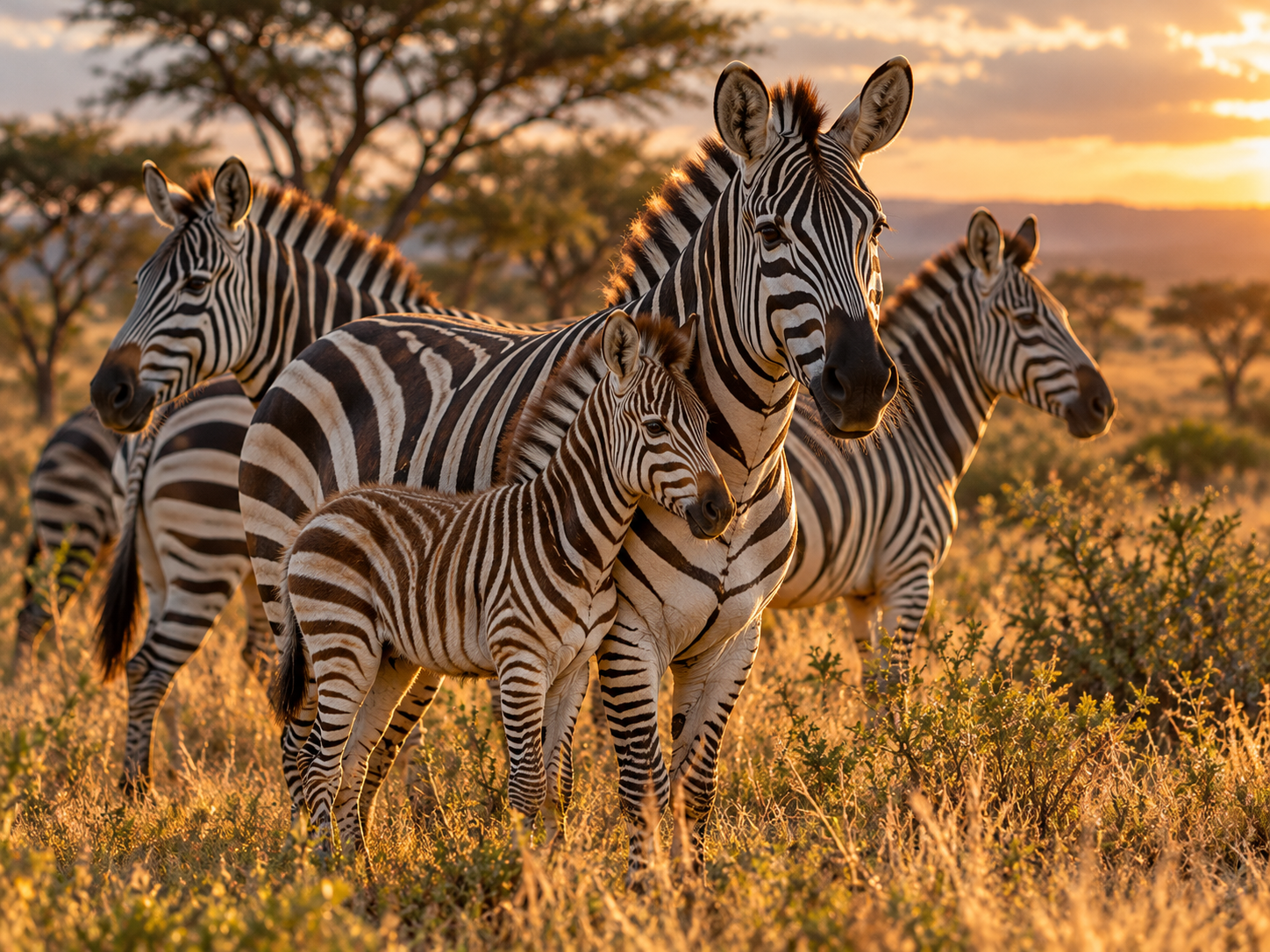
Imagine watching a herd of zebras moving across the South African veld in the early morning light.
At first, you notice the movement. Black and white bodies drift through the golden grass, occasionally disappearing behind thorn trees before emerging into the open again. A foal stays close to its mother. Another zebra lifts its head, ears turning towards a distant sound. Somewhere in the herd, a stallion pauses while the others continue grazing.
It is a familiar African scene. Beautiful, peaceful and unmistakably wild.
But look a little closer.
Every zebra in that herd is wearing a different pattern. Every stripe, curve and broken line contributes to an individual design that no other zebra shares exactly.
And here is the fascinating part: despite decades of research, scientists are still investigating why zebras evolved such extraordinary markings in the first place.
The latest research has uncovered compelling evidence, but Africa’s most recognisable pattern still holds secrets.
For wildlife enthusiasts and photographic safari travellers, this is one of the wonderful things about Africa. Sometimes the animals we think we know best turn out to be the ones with the most fascinating stories.
No Two Zebras Are Exactly Alike
A zebra’s stripes are more than decoration.
Much like fingerprints can distinguish people, individual stripe patterns can help researchers distinguish one zebra from another. The arrangement of lines differs between animals, making their coats useful for identification through photography.
South Africa’s National Biodiversity Institute (SANBI) identifies individual striping as one of the defining features of Burchell’s zebra, a form of the plains zebra familiar to many visitors to Southern Africa.
Spend enough time watching a herd, and the differences become noticeable.
One animal may have broad stripes across its shoulders. Another may have narrower markings around its legs. The shape of the stripes along the neck, flank and rump may differ subtly from its companions.
From a distance, these differences merge into the familiar black-and-white appearance we associate with zebras. Up close, however, each animal becomes unmistakably individual.
Interesting wildlife fact: In June 2026, researchers at the University of Stuttgart described an identification system called RAPID that can compare distinctive visual features, including zebra stripe patterns, with known individuals in an image database. The technology illustrates how something as simple as an animal’s natural markings can contribute to wildlife research.
For safari photographers, that adds another dimension to the experience. You are not merely photographing a herd. You are photographing individual animals, each with its own identity and place within the group.
Africa Is Home to Three Living Zebra Species
Although most people simply call them zebras, there are three living zebra species, and their appearances and habitats are not identical.
Plains Zebra: The Familiar Face of the Savanna
The plains zebra (Equus quagga) is the most widespread zebra species. Found across parts of Eastern and Southern Africa, it inhabits grasslands, savannas and open woodland.
It is the zebra many travellers encounter on their first African safari.
Plains zebras are social animals, often living in stable family groups that include a stallion, mares and their offspring. They may also gather in larger herds when conditions bring different groups together.
Their markings vary geographically and between individuals, adding to the visual diversity within the species.
Mountain Zebra: Built for Rugged Country
The mountain zebra (Equus zebra) is associated with more mountainous and rocky environments.
Its two recognised subspecies are the Cape mountain zebra, native to South Africa, and Hartmann’s mountain zebra, associated particularly with Namibia and parts of south-western Africa.
Mountain zebras differ from plains zebras in body shape and stripe arrangement, with notably white bellies and distinctive markings around the hindquarters.
They are a wonderful reminder that wildlife adapts not only to climate but also to the physical character of the land.
In South Africa, Mountain Zebra National Park provides one of the country’s most important conservation stories. Established in 1937 to protect Cape mountain zebras, the park has played a significant role in the recovery of the subspecies.
Grévy’s Zebra: The Rare Northern Relative
Grévy’s zebra (Equus grevyi) is the largest of the living zebra species and is native to parts of East Africa, particularly Kenya and Ethiopia.
It has a narrower stripe pattern, unusually large ears and a more slender, mule-like appearance.
It is also considerably rarer than the plains zebra.
While it is not a typical South African safari animal, its existence highlights something remarkable: even closely related animals can develop striking differences in appearance and behaviour.
Together, Africa’s three zebra species offer a fascinating example of wildlife diversity.
The Big Question: Why Do Zebras Have Stripes?
For generations, people have proposed explanations for the zebra’s extraordinary coat.
Perhaps the stripes provide camouflage. Perhaps they confuse predators. Perhaps the contrasting colours help regulate body temperature. Or perhaps they allow zebras to recognise one another.
These are appealing theories, and they have inspired extensive scientific debate.
One explanation, however, has gained particularly strong experimental support.
Zebra stripes appear to help reduce landings by certain biting flies.
That may sound surprisingly ordinary for something so visually spectacular, but in the natural world even a small advantage against persistent parasites can matter.
Biting flies can cause irritation, blood loss and, in some circumstances, transmit disease. Anything that reduces their ability to land successfully may offer a survival advantage.
Researchers have spent years investigating whether black-and-white markings make zebras less attractive landing surfaces.
And the results have been fascinating.
The Surprising Connection Between Stripes and Biting Flies
A 2019 study published in PLOS ONE investigated the behaviour of horseflies around zebras and domestic horses.
The researchers found that the flies had difficulty landing successfully on the striped surfaces. Experiments involving striped coverings provided additional evidence that the pattern itself influenced landing behaviour.
A later study published in Scientific Reports in 2022 examined striped zebra pelts and uniformly coloured impala pelts in a Kenyan savanna setting.
The flies in that experiment showed a strong preference for landing on the uniformly coloured pelts rather than the striped zebra pelts.
In other words, the stripes appeared to make the surface less appealing or more difficult for the flies to land upon.
The precise visual mechanisms involved are still being investigated. Scientists have explored how contrast, pattern scale and visual perception influence the final moments of a fly’s approach.
It is an extraordinary possibility.
An animal famous worldwide for its spectacular appearance may owe an important part of that appearance to an evolutionary relationship with something as small as a biting insect.
And yet the scientific story does not end there.
Scientists Are Still Searching for the Complete Answer
In 2025, researchers Hamish Ireland and Graeme Ruxton published a detailed scientific review in Biological Reviews examining the leading explanations for zebra stripes.
Their conclusion was nuanced.
Although evidence for biting-fly deterrence is strong, that explanation alone does not account for every feature of zebra striping.
For example, why do stripes vary so much between zebra species? Why are some markings broad while others are narrow? Why do different parts of the body have different arrangements? And why have other large African grazing animals not evolved similarly dramatic patterns?
The researchers examined additional possibilities, including signalling between animals and the effects of stripes on visibility.
Some ideas remain interesting hypotheses rather than established explanations.
The important conclusion is that the question is not completely settled.
Scientists have strong evidence that stripes deter certain biting flies, but the complete evolutionary explanation remains an active area of research.
For the curious traveller, that makes the zebra even more remarkable.
Sometimes nature’s greatest mysteries are standing in front of us, quietly grazing.
Do Zebra Stripes Confuse Lions?
This is one of the most commonly repeated explanations for zebra markings.
The theory suggests that moving stripes might make it difficult for predators to distinguish individual animals within a running herd.
It is an appealing image: dozens of black-and-white bodies moving together, their patterns creating a confusing visual spectacle.
But the scientific evidence is much less convincing than the story.
Research has not demonstrated that zebra stripes reliably prevent lions from targeting or capturing zebras. Lions are effective predators, and zebras remain an important prey species in many African ecosystems.
Likewise, the idea that zebra stripes primarily evolved as camouflage has not received the same level of experimental support as the biting-fly explanation.
This does not make the stripes any less extraordinary. It simply reminds us that nature does not always follow the explanation that first seems obvious to the human eye.
Could the Stripes Help Keep Zebras Cool?
Another popular theory suggests that black and white stripes might influence heat exchange.
Because dark and light surfaces absorb and reflect sunlight differently, researchers have investigated whether temperature differences between stripes might create air movement or help regulate heat.
However, studies have not established that zebra stripes provide a meaningful cooling effect through this proposed mechanism.
The 2025 scientific review found important difficulties with this explanation, particularly when considering the distribution of stripes across different body regions and species.
Zebras certainly need to manage heat in demanding African environments, but their stripes should not be described as a proven natural cooling system.
The distinction matters.
Good wildlife storytelling becomes even more interesting when we separate what science has demonstrated from what remains possible.
Zebra Families Have Their Own Stories
Beyond the science of their markings, zebras are fascinating because of their social behaviour.
Plains zebras often live in family groups that remain together over long periods.
A stallion may travel with several mares and their offspring, while other males form bachelor groups. During movements through suitable grazing areas, multiple families can associate in larger aggregations.
Watch a herd carefully, and the relationships begin to reveal themselves.
A foal moves close to its mother. Adults maintain awareness of nearby movement. Individuals use calls, ear positions and other visual signals as they interact.
These details create some of the most beautiful wildlife photography opportunities.
A photograph of two zebras standing side by side can be visually striking because of their patterns. But an image showing a mare and foal interacting tells a deeper story.
It captures a relationship rather than simply an animal.
For guests travelling on a photographic safari, learning to recognise behaviour can transform an ordinary sighting into a memorable encounter.
The Important Role Zebras Play in African Grasslands
Zebras are not merely beautiful animals moving across the landscape. They also influence the habitats they occupy.
As grazing herbivores, plains zebras consume a range of grasses. Unlike some more selective grazers, they can feed on coarser vegetation.
This has earned them the description pioneer grazers in certain ecosystems.
By feeding on taller or less palatable grasses, they can alter grazing conditions for other herbivores, including animals that prefer shorter or more nutritious growth.
Their movements also form part of the wider ecological rhythm of savannas and grasslands.
Where zebra populations, rainfall and habitat conditions interact, the landscape becomes a dynamic system rather than a static background.
For safari visitors, this adds another way to appreciate the veld.
The herd grazing in front of you is part of a much larger story involving vegetation, water, predators, soil and seasonal movement.
A Conservation Story Worth Knowing
South Africa’s Cape mountain zebra provides an encouraging example of what sustained wildlife protection can achieve.
Mountain Zebra National Park was established specifically to help protect the Cape mountain zebra at a time when the subspecies had become dangerously scarce.
Through protection, habitat management and the establishment of additional populations, its numbers increased significantly over subsequent decades.
The species remains an important focus of research and conservation management.
Zebras also illustrate how modern technology can support wildlife monitoring.
Because individual stripe patterns are distinctive, researchers can use photographs and image-recognition methods to help identify animals without necessarily needing physical tags or invasive identification procedures.
As technology advances, wildlife photography is becoming increasingly valuable beyond tourism.
The same characteristics that make an animal beautiful to photograph can also make it possible to monitor populations and study their movements more effectively.
How to Appreciate Zebras on Your Next Photographic Safari
Zebras are among the most rewarding animals to photograph, but the best images often come from looking beyond the obvious.
Rather than immediately photographing the first zebra you see, spend a little time observing the group.
Look for a foal following its mother. Notice how the animals turn their ears towards sounds. Watch the patterns created when several zebras stand together. Observe the contrast between their markings and the colours of the surrounding veld.
A close-up photograph of the face can reveal delicate details around the eyes and ears. A side-on photograph can highlight the unique stripe pattern. A wider landscape image can capture the relationship between the herd and its environment.
Black-and-white photography can produce particularly striking images, although the natural colours of the bush are often equally beautiful.
Above all, be patient.
Do not pressure wildlife into moving or approaching. The most memorable photographs are often those captured when the animals are behaving naturally and the photographer allows the moment to unfold.
A zebra drinking quietly beside a waterhole can be just as captivating as a herd moving across open grassland.
The secret is learning to see the familiar in a new way.
Where Can You See Zebras in Southern Africa?
Plains zebras occur across suitable habitats in several Southern African safari destinations, although individual populations and viewing opportunities vary by reserve.
South Africa offers opportunities to see plains zebras across a variety of national parks and private wildlife areas. Botswana’s grasslands and savannas provide memorable herd encounters, while Namibia offers the additional interest of Hartmann’s mountain zebras in suitable habitats.
Zimbabwe, Zambia and parts of Mozambique also support zebra populations, while Tanzania offers extraordinary plains zebra viewing across major savanna ecosystems.
South Africa’s Mountain Zebra National Park is particularly noteworthy for travellers interested in the conservation story of the Cape mountain zebra.
Each destination provides a different photographic atmosphere, from open plains and river valleys to rocky mountain landscapes.
At Infinite Safaris Africa, we can help guests explore photographic safari destinations across South Africa, Botswana, Namibia, Zimbabwe, Zambia, Mozambique and Tanzania.
The right itinerary depends on the animals you hope to see, the landscape you want to experience and the time of year you plan to travel.
Frequently Asked Questions
Why do zebras have black and white stripes?
Current experimental evidence strongly supports the idea that stripes help reduce landings by certain biting flies. However, scientists are still investigating why stripe patterns vary so much between zebra species and across different parts of their bodies.
Does every zebra have a different stripe pattern?
Yes. Individual zebras have distinctive stripe patterns that can help researchers and observers distinguish one animal from another.
Do zebra stripes protect them from lions?
There is insufficient evidence that stripes reliably confuse lions or prevent predation. Zebra survival also depends on vigilance, group behaviour, movement and habitat.
Which zebra species can I see in South Africa?
South Africa is home to plains zebras and Cape mountain zebras, while some suitable areas may also support managed populations of other zebra forms. The species present depends on the destination.
The Beauty of Looking Closer
There is something fitting about the zebra being one of Africa’s most recognisable animals while still holding unanswered scientific questions.
It reminds us that a safari is not only about discovering something we have never seen before.
Sometimes it is about seeing something familiar with entirely new eyes.
The next time you encounter a zebra, look beyond the stripes.
Notice the individual animal. Watch its behaviour. Observe the family group. Appreciate the grassland around it and the extraordinary history behind its markings.
You may discover that one of Africa’s most familiar animals has a far more fascinating story than you ever imagined.
Discover Africa Beyond the Ordinary
At Infinite Safaris Africa, we believe an unforgettable safari is built around moments of discovery. Whether your dream involves photographing zebras on open plains, observing elephants beside a river or exploring the extraordinary wildlife of Southern Africa, we would love to help you create a journey that reflects your interests.
Contact Infinite Safaris Africa and tell us which animals you would most love to experience.
Become part of our great safari heritage.
