
A great African safari does not begin with a date on a calendar.
It begins with a question.
What do you want to see?
For some travellers, the answer is lions in golden light. For others, it is elephants gathered at water, leopards in riverine shade, wild dogs on the move, giraffes beneath wide skies, or birds rising from a wetland at dawn. Some guests want dramatic predator action. Others want peaceful photographic moments, open landscapes, family-friendly wildlife viewing, or the beauty of the green season.
This is why choosing the best time for an African safari should never be a random decision.
The animals should guide the plan.
Africa changes constantly through the year. Rainfall shifts the landscape. Water sources appear and disappear. Grass grows tall, then thins again. Migratory birds arrive and leave. Rivers rise and fall. The light changes. The heat changes. Wildlife movement changes with it.
That is why the best safari is not only about choosing the right lodge or country. It is about choosing the right season for the kind of wildlife experience you want.
At Infinite Safaris Africa, this is one of the most important parts of planning. We do not believe every guest should be placed into the same type of itinerary. The right safari should match your interests, your comfort level, your photography goals, your preferred pace and the animals you most want to experience.
Why timing matters so much
Wild animals do not move according to human schedules.
They move according to water, food, temperature, breeding cycles, safety, light and habitat. If you understand those natural patterns, you can plan a safari that gives you a better chance of experiencing the kind of moments you have in mind.
This does not mean safari can ever be guaranteed. It cannot, and that is part of its beauty. The wildness of the experience is what makes it meaningful. But good timing can greatly improve the quality of your days in the field.
A dry-season safari may offer clearer visibility and more predictable wildlife movement around water. A green-season safari may offer dramatic colour, migratory birds, newborn animals and breathtaking skies. A river-based safari may be strongest when animals rely heavily on permanent water. A desert safari may become more dramatic when dry conditions pull wildlife towards waterholes.
Every season has value. The secret is knowing which season matches your dream.
Dry season: the classic wildlife window
For many safari travellers, the dry season remains the most popular choice.
In much of Southern Africa, the dry winter months are known for thinner vegetation, cooler mornings and strong wildlife viewing. As natural water becomes scarcer, animals often move more regularly towards rivers, dams, pans and waterholes. This can make game viewing easier and more predictable.
This is especially helpful for first-time safari guests.
When the bush is open, guests can see further. Tracks are often easier to read. Animals may be less hidden by thick grass and foliage. Predators may follow the movement of prey, especially around water and open feeding areas.
Dry season is also excellent for photography. The light can be clean and golden. Dust can add atmosphere to images. Wildlife often stands out strongly against dry grass and open backgrounds. For guests who want classic African safari images, this season offers powerful opportunities.
The dry season does not mean the land is empty or lifeless. It means the landscape becomes more readable. For many guests, that makes the experience deeply satisfying.
Green season: colour, life and atmosphere
The green season offers a different kind of magic.
After rain, the bush transforms. Grass lifts. Trees flush. Flowers appear in certain areas. Water fills low places. The sky becomes dramatic. Clouds build in huge shapes across the horizon. The entire landscape feels refreshed.
For photographers, this can be extraordinary.
Animals stand against rich green backgrounds. Birds become more active and colourful. New life appears in the veld. The air feels clean after rain. Light breaks through cloud in unexpected ways. Instead of the classic golden-brown safari look, guests experience a fuller, more atmospheric Africa.
The green season is often misunderstood. Some travellers assume that if the bush is thicker, it must be a lesser safari season. That is not true. It is simply different.
The green season rewards patience and appreciation for the full landscape. It is ideal for guests who love birds, dramatic skies, rich colours, fresh vegetation, landscape photography and the feeling of Africa renewed by rain.
Water decides more than people realise
If there is one natural force that shapes safari more than anything else, it is water.
Water influences where animals feed, drink, rest and move. In dry times, it concentrates life. In wet times, it allows animals to spread out. Around rivers, dams and pans, entire wildlife stories unfold.
Elephants may arrive in family groups. Buffalo may gather in numbers. Antelope may approach carefully. Predators may lie in shade nearby. Birds may work the edges. Hippos and crocodiles bring their own kind of drama to river systems. Tracks in the mud reveal what came before you.
This is why water-based safari regions are so powerful.
Botswana’s waterways, Zambia’s river valleys, Zimbabwe’s floodplains, South Africa’s dams and river systems, Namibia’s waterholes, and Mozambique’s restored wilderness areas all offer different versions of the same truth: water brings the land to life.
When choosing your safari dates, it helps to ask where the water will be and how wildlife will respond to it.
If you want predators
Many travellers dream of seeing predators.
Lions, leopards, cheetahs, hyenas and wild dogs all hold a particular fascination. They bring tension and drama to a safari because their lives are shaped by movement, opportunity and instinct.
If predators are a major focus, dry-season safaris can be excellent because prey movement is often easier to anticipate. Open vegetation may also improve visibility. In certain regions, predators use riverbeds, water edges, roads and shaded thickets in ways experienced guides understand well.
But predator sightings are not only about season. They are also about habitat and guiding.
Leopards often need riverine areas, rocky places or thick cover. Cheetahs prefer more open ground. Wild dogs may move across large distances. Lions may be linked to prey concentrations and territorial patterns. Hyenas may appear around kills, water points or night-time activity.
This is where local knowledge becomes invaluable. The right guide does not simply drive and hope. They read signs, behaviour, tracks, bird calls, weather and movement.
If you want elephants
Elephants are among Africa’s most unforgettable animals.
Their size is impressive, but it is often their behaviour that stays with guests: the way a matriarch leads, how calves remain protected, how family groups communicate, how gently such powerful animals can move through the landscape.
For elephant-focused safaris, water and season matter greatly. Elephants need regular access to water and often create powerful photographic moments near rivers, dams and waterholes. Dry periods can make these areas especially rewarding, while green seasons may show elephants in softer, richer landscapes.
Botswana’s Chobe region, parts of South Africa, Zimbabwe, Zambia and other Southern African destinations can offer excellent elephant experiences depending on season and itinerary.
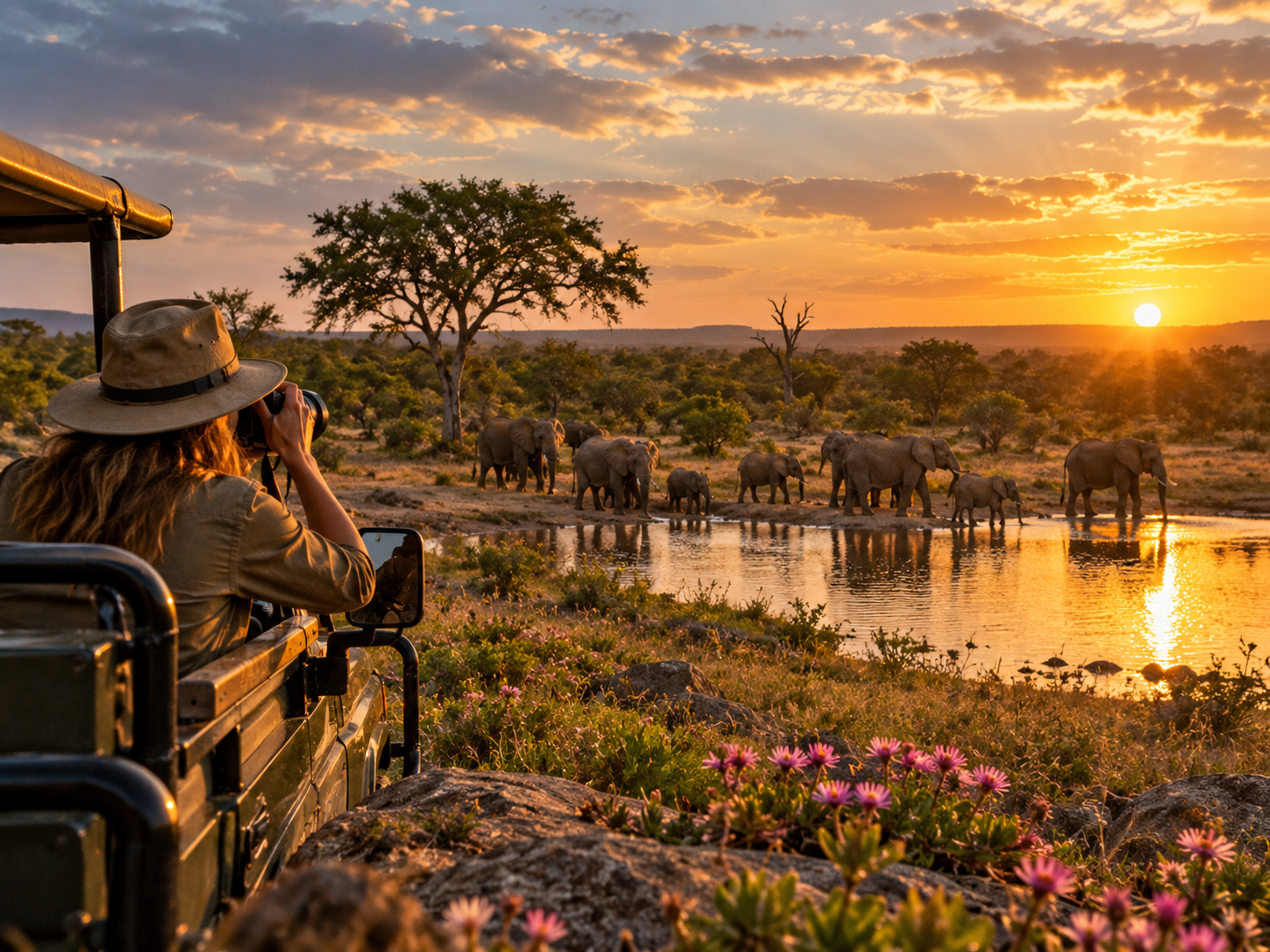
For photographers, elephants are ideal subjects because they offer movement, emotion, texture, dust, reflection and scale. A herd near water at sunset can become one of the defining images of a safari.
If you want birds
Birdlife deserves more attention in safari planning.
Many guests arrive focused on large mammals and leave surprised by how much they enjoyed the birds. Fish eagles, bee-eaters, rollers, hornbills, vultures, cranes, storks, waterbirds and raptors can transform a safari from good to unforgettable.
Birding is especially strong in wetter and warmer months when many species are breeding, displaying or migrating. Water systems, wetlands, bushveld edges and riverine areas can be particularly rewarding.
For photographers, birds offer colour, action and challenge. They also keep the day interesting between larger sightings. Sometimes the best moment of a drive is not a lion or elephant, but a bird catching light perfectly against the sky.
If birdlife is important to you, the best safari season may not be the same as the best big-game season. That is why your personal interests should shape your travel dates.
If you want landscapes and atmosphere
Not every safari traveller is chasing close-up wildlife encounters only.
Some want the feeling of Africa. The space. The sky. The roads. The trees. The silence. The shape of animals in the distance. The drama of weather. The colour of the earth.
For these guests, the best season may depend more on atmosphere than on pure wildlife density.
Namibia is unforgettable for desert light and clean compositions. Botswana offers water, reflections and floodplain drama. South Africa provides variety, from bushveld to semi-arid landscapes and coastal regions. Zimbabwe and Zambia offer river systems, floodplains and a wilder visual mood. Mozambique brings restoration landscapes and tropical contrast.
A photographic safari built around atmosphere may combine more than one country or habitat. This allows guests to return home with a more complete visual story: dry country, green country, water, dust, animals, skies and people.
Why popular safari months book early
The best safari months often fill quickly.
This is especially true for premium lodges, private guides, family groups and custom itineraries. Travellers who wait too long may still be able to travel, but they may have fewer choices of room type, route, guide availability and preferred dates.
That is why planning early is valuable.
It gives guests time to choose properly instead of settling for what remains. It allows the itinerary to be shaped around the animals, not only around availability. It also gives international travellers time to arrange flights, documents, equipment, travel insurance, health considerations and any special interests such as photography, hunting, birding or family activities.
A safari is not the kind of trip that should feel rushed in the planning stage. The more carefully it is built, the better it usually feels on the ground.
How to choose your safari month
The best way to choose your safari month is to start with your priorities.
Do you want classic wildlife visibility?
Look at the dry season.
Do you want green landscapes, birds and dramatic skies?
Consider the green season.
Do you want elephants around water?
Choose regions and months where water movement is important.
Do you want predators?
Ask about habitat, guiding and prey patterns.
Do you want a family-friendly trip?
Consider weather, travel distances and lodge comfort.
Do you want photography?
Think about light, background, vehicle access, patience and guide flexibility.
Do you want a combination safari?
Build the route around contrast: bushveld, water, desert, river, open plains and lodge comfort.
The right answer will not be the same for every guest. That is the point.
Why custom planning makes the difference
A safari should never feel like a generic package when the wildlife itself is never generic.
The best itineraries are built around the guest and the land. They consider where animals are likely to be, what the season is doing, what the guest wants most, and how to make the experience flow naturally from one day to the next.
At Infinite Safaris Africa, this is where our planning matters.
We help guests think beyond the question of “When can I travel?” and move towards a better question: “What do I want my safari to feel like?”
From there, the right plan begins to take shape.
Some guests may be best suited to September’s dry-season visibility and spring atmosphere. Others may prefer the green season for colour and birdlife. Others may want a cross-border photographic safari through Southern Africa’s national parks and private reserves. Others may want a carefully guided hunting safari combined with relaxed lodge time and wildlife viewing.
There is no single best safari for everyone. There is only the best safari for you.
The animals are the heart of the journey
At the centre of every great safari is wildlife.
Not only the famous animals, but the full living system around them. The birds, tracks, insects, grasses, trees, predators, prey, water, weather and silence. The more you understand this, the more meaningful your safari becomes.
Planning around the animals does not remove the mystery. It deepens it.
It helps you travel at the right time, to the right place, with the right expectations. It helps you appreciate why a quiet morning may still be full of signs. It helps you understand why a waterhole matters, why a leopard chooses shade, why birds become active before rain, why antelope move differently when the wind changes.
A safari planned around animals is not only better for sightings. It is better for the soul of the experience.
Conclusion
Choosing the best time for an African safari is not only about weather charts or travel calendars.
It is about wildlife.
It is about understanding how animals move, feed, drink, rest and respond to the seasons. It is about choosing a time of year that matches the experience you want most. It is about knowing when the veld is open, when the water matters, when the birds are active, when the light is beautiful and when the landscape tells the story you want to capture.
Africa offers many safari seasons, and each has its own magic.
The dry season brings visibility, waterhole activity and classic game viewing.
The green season brings colour, renewal, birdlife and dramatic skies.
Spring brings change, warmth and fresh energy.
River seasons bring movement and life to the water’s edge.
Desert seasons bring silence, scale and powerful light.
The best safari is the one planned with intention.
Tell us what animals you dream of seeing, what moments you hope to experience, and what kind of journey you want to remember.
We will help you choose the season that brings that dream closer.
